

Description
Real Estate Office Branding vs Aesthetic Wallpaper
While all wallpaper serves to cover a wall, the difference between Real Estate Office Branding murals and standard decorative wallpaper lies in their purpose, durability, and psychological impact.
Standard wallpaper is typically about aesthetics or texture. But real estate office branding is a strategic business tool designed to communicate trust and local expertise.
Let us look at how a wall transitions from being a background element (standard wallpaper) to an active business tool (real estate branding).
1. Strategic Intent: “Ambiance” vs. “Authority”.
The Goal
Standard wallpaper is selected based on personal taste or interior trends (e.g., a “Boho” or “Industrial” look). Its job is to make a room feel finished. Real Estate Office Branding is selected based on market positioning. It aims to establish “hyper-local authority.” This transformation shifts the environment from a simple decorative space into a high-impact business tool that builds trust.
The Execution
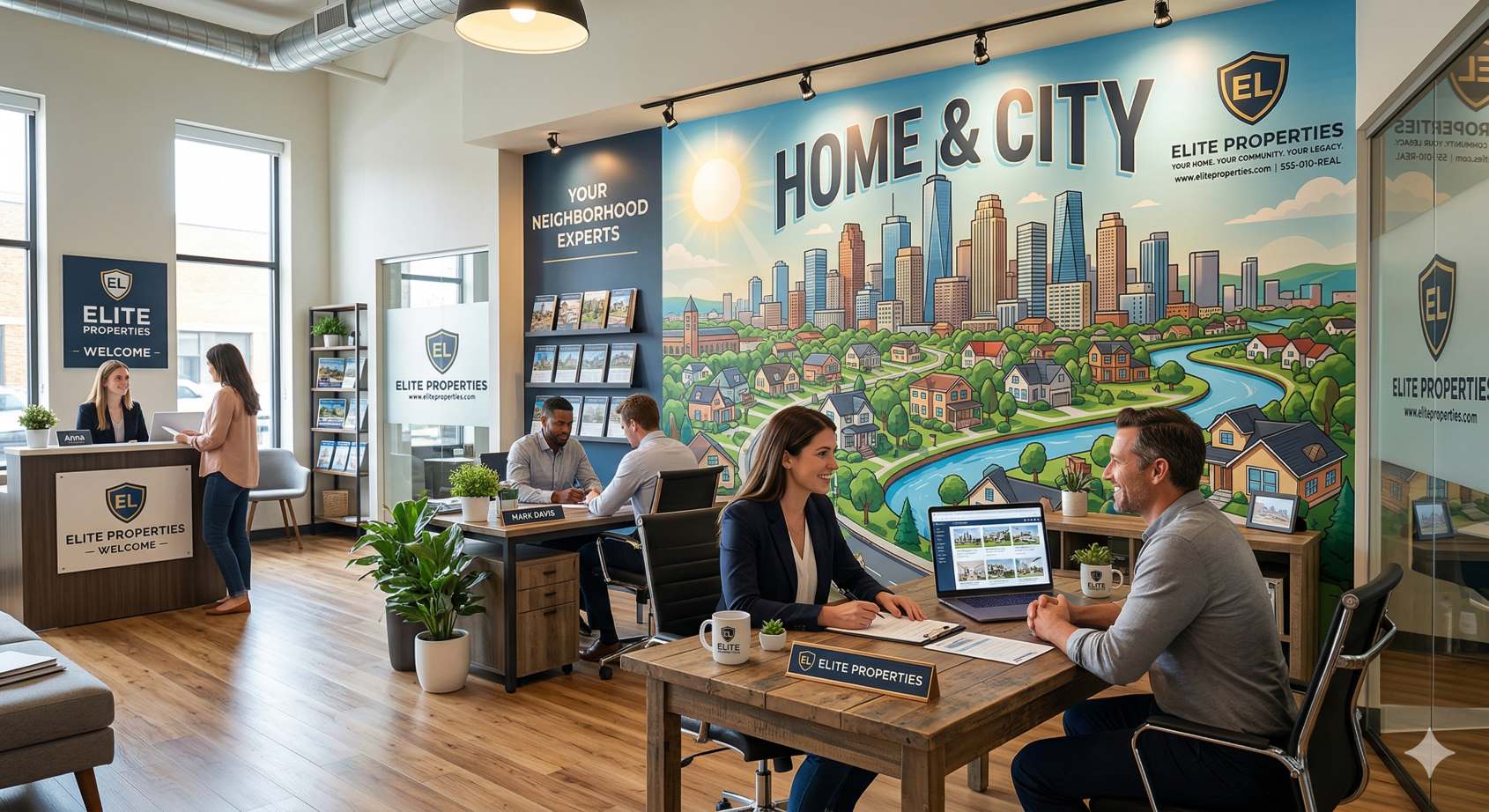
Instead of a generic pattern, a branded mural might feature a high-contrast topographic map of a specific neighborhood. When a client walks in, the wall immediately signals: “We own this area; we know every street shown here.” It’s a visual handshake that validates the firm’s expertise and deep community roots, turning a functional wall into a powerful marketing asset.
2. Real Estate Office Branding uses “Hero” Scaling
Standard wallpaper follows a mathematical repeat, where a pattern cycles every 20–30 inches. This is purely decorative. In contrast, “Hero” Scaling treats the entire wall as a single, non-repeating canvas, custom-engineered to function within the specific physical layout of a real estate office.
The Logo Placement
Designers use “Hero” Scaling to ensure brand assets are never blocked by office infrastructure. By mapping out “Dead Zones”—areas hidden by desks, sofas, or filing cabinets—and “Active Zones” at eye level, the logo is placed with mathematical precision. This ensures that whether a client is standing at reception or seated for a closing, the brand remains perfectly visible and unobstructed.
Information Density
Unlike decorative patterns, branded murals act as high-density information hubs. They integrate “Operational Data” directly into the aesthetic. These may include the timeline of the agency’s historical milestones or a modular “Property Showcase” grid. This turns a static wall into a dynamic sales tool. And providing agents with a visual aid to walk clients through the firm’s track record and current market reach.
3. Material Science: “Residential” vs. “Contract Grade”.
While high-end standard wallpaper exists, most are made of paper or non-woven fibers that can tear or scuff.
Real Estate Branding almost exclusively uses Type II Vinyl (Contract Grade):
Durability
These offices are high-traffic zones. Agents are moving chairs, clients are leaning against walls, and marketing materials are being moved around. Type II Vinyl is “scrubbable” and fire-rated for commercial safety codes.
Non-Reflective Finishes
Walls are often the backdrop for agent headshots or social media videos. Therefore, we use a “Matte” or “Suede” finish to prevent camera glare from overhead office lights.
4. Psychological Impact of Real Estate Office Branding
Standard wallpaper is designed primarily to influence a room’s atmosphere. For instance, a soft blue grasscloth is chosen to evoke a sense of “calm.” However, in a professional setting, real estate murals transcend simple aesthetics to drive Conversion. They are engineered to shift a client’s mindset from casual interest to firm trust. We use visual cues that broadcast success and reliability before a single word is spoken.
Residential Offices
In residential settings, murals leverage “Lifestyle Imagery” to act as a psychological catalyst. By featuring aspirational, high-resolution vistas of iconic local architecture or sun-drenched interior sanctuaries, these designs help clients mentally “move in.” This visual storytelling bridges the gap between a financial transaction and an emotional milestone, allowing the agent to foster a sense of hope and excitement that accelerates the decision-making process.
Commercial/Industrial Offices
For commercial or industrial sectors, branding shifts toward “Structural Authority.” Here, murals often display intricate technical blueprints, site maps, or “Development Timelines” that showcase a history of successful project management. By visually documenting a track record of high-scale transactions, the wall becomes a silent “closing tool.” It reassures investors and stakeholders of the agent’s competence in navigating complex, high-stakes logistics and industrial growth.
Design Note
A common mistake is trying to do both. Putting a company logo on top of a busy floral wallpaper often looks cluttered. True branding integrates the logo into the design (e.g., a subtle watermark over a city map) for a cleaner, more professional finish.
1. Narrative vs. Aesthetic
Integrating a wallpaper mural is about more than just decoration; it’s a strategic move to turn your physical office into a silent salesperson. In real estate, where trust and local knowledge are your primary currencies, these two narrative directions serve very different branding goals:
The “Neighborhood Expert” Mural
This design functions as a visual credential. By featuring a hyper-local map with custom-illustrated landmarks—like a specific clock tower, a beloved park, or a historic bridge—you immediately signal deep-rooted community ties. It’s an interactive conversation starter that allows agents to literally point out market trends and neighborhood boundaries, reinforcing their status as the definitive local authority to every walk-in client.
The Mission Statement
This approach transforms your office into a permanent, large-scale pitch deck. Rather than just a logo, this mural weaves your core values—like “Integrity,” “Community,” or “Innovation”—directly into a sophisticated graphic layout. It ensures that every client who enters or sits in your waiting area is subconsciously absorbing your brand’s DNA, creating a professional environment where your company’s promise is literally built into the walls.
2. Durability for High-Traffic Areas
When selecting the material for a real estate branding mural, the primary concern is longevity. An office mural is a long-term investment that needs to withstand the daily activity of agents, clients, and maintenance crews without losing its professional polish.
Commercial Grade (Type II)
For a professional real estate lobby, Type II vinyl is the industry standard for durability. These heavy-duty wallcoverings are engineered to resist scuffs, scratches, and impact in high-traffic corridors. They carry essential fire-safety ratings and feature a protective coating that allows for deep cleaning with commercial detergents, ensuring your brand colors remain vibrant and professional for years.
Home Grade
Standard residential wallpapers, often made of thin paper, non-woven fibers, or delicate silks, are designed for low-impact environments like bedrooms. In a busy office, these materials are prone to tearing, staining, and “burnishing” (shiny marks from people leaning against walls). Without a vinyl top-coat, they lack the moisture resistance needed to survive frequent cleaning in a public space.
3. Custom Dimensions & Scale
When designing a professional real estate office, the way the image fits your wall is the difference between a DIY project and a high-end corporate brand. Standard rolls are meant to blend in, while custom murals are meant to stand out.
Wallpaper (Repeating Rolls)
Standard wallpaper is sold in fixed-width rolls (usually 21 or 27 inches) with a repeating pattern. Whether your wall is 8 feet or 20 feet wide, the design simply restarts every few inches. This is ideal for subtle textures or small geometric prints, but it makes it nearly impossible to feature a large, cohesive brand logo or a continuous neighborhood map without awkward, distracting breaks in the visual flow.
Office Branding Murals (Scaled to Fit)
Branding murals are digitally printed to your wall’s exact dimensions, treated as one massive canvas. This “scaled to fit” approach ensures that your agency’s logo or a key local landmark is positioned perfectly at eye level. Designers can even adjust the artwork during production. So that critical branding elements aren’t cut off by doorways, light switches, or bulky reception desks, resulting in a seamless, bespoke architectural feature.
The “Furniture-First” Rule
Before finalizing your mural dimensions, measure the height of your reception desk and any monitor mounts. A common mistake in real estate offices is placing the company tagline or a key neighborhood detail too low. This only to have it completely obscured by a computer screen or a client chair once the office is furnished.
4. The “Trust” Factor in Real Estate Office Branding
In real estate, the environment needs to feel professional and stable. A branded wall acts as a “silent closer.” When a client sits in a glass-walled meeting room, a backdrop of a beautifully rendered local skyline or a clean, modern brand logo subconsciously validates the agency’s professionalism.
Pro Tip
If you are looking to update an office space, consider removable silk fabric for branding. It allows for high-quality custom printing. But you can swap it out easily if the brand refreshes its logo or you move office to a new location.
Branding Real Estate Office Beyond Wallpaper Murals
Branding a real estate office goes far beyond the walls. It’s about creating an environment that signals trust, local expertise, and professionalism the moment a client walks in. The focus shifts toward tactile materials, lighting, and functional branding.
Here are several effective ways to brand a real estate workspace:
Dimensional Signage and Logo Walls Office Branding
Moving away from 2D surfaces like wallpaper, dimensional signs add depth and a premium feel. When a logo is physically layered—whether through thick acrylic, brushed brass, or matte aluminum—it suggests stability and permanence. This tactile quality reassures clients that your firm is an established pillar of the local property market. Not a temporary or fly-by-night operation.
Backlit Acrylic or Metal
Mount your logo using “stand-offs” to create a shadow effect that gives the brand a floating, architectural quality. Adding LED halo lighting behind the letters makes the brand pop even in low light, creating a sophisticated glow. This technique is particularly effective for luxury or commercial real estate offices, as it mimics the high-end signage found in premium corporate plazas.
Moss Walls
Incorporating preserved reindeer moss with a laser-cut wood logo combines a modern aesthetic with an “eco-friendly” or “growth” message, which resonates well in property markets. Biophilic design—bringing the outdoors in—is proven to reduce anxiety during stressful negotiations. It signals that your brand values sustainability and well-being, providing a lush, organic contrast to the often-rigid world of contracts and blueprints.
2. Functional “Neighborhood” Zoning
In real estate, your product is the community. Use the office layout to reflect your local expertise by transforming your workspace into a physical extension of the areas you serve. When clients see your office organized around the geography they care about, it builds immediate confidence in your team’s hyper-local knowledge and presence within those specific market segments.
Themed Meeting Rooms
Instead of “Meeting Room A,” name rooms after local landmarks or neighborhoods. Use specific paint colors or decor accents—like vintage local maps framed in high-quality wood—to distinguish them. This subtle branding strategy anchors your office in the community. And makes every closing or consultation feel like a celebration of a specific neighborhood’s unique character and investment potential.
Interactive Map Displays
A large, glass-encased map of the city or region where agents can mark “Recently Sold” or “Coming Soon” properties acts as both a branding tool and a conversation starter. It serves as a visual “scoreboard” of your success, showing clients exactly where you are active. This transparency demonstrates your firm’s momentum and deep-rooted connectivity across the regional property landscape.
3. Custom Millwork and Architectural Features
Physical structures and architectural details act as the “bones” of your brand. Unlike temporary decor, custom millwork communicates a sense of permanence and significant investment, mirroring the high-stakes nature of real estate transactions.
Signature Reception Desk
Your reception desk is the first “handshake” your brand offers. Use materials that reflect the specific properties you represent. For luxury residential, marble or fluted oak conveys timeless elegance and high value. For industrial or commercial real estate, raw steel or polished concrete signals a no-nonsense, functional, and modern approach that resonates with business-minded developers and investors.
Glass Partition Graphics
To maintain an open, collaborative feel without sacrificing privacy, use glass partitions with frosted “distraction strips.” These can incorporate your logo or a subtle geometric pattern inspired by architectural blueprints. This technique balances the transparency of your business practices with the necessary confidentiality required for high-level negotiations, all while reinforcing your visual identity at every eye-level transition.
4. Sensory Real Estate Office Branding (Lighting & Scent)
Branding is not just a visual experience; it is an atmospheric one that lingers long after a client leaves. When you engage multiple senses, you bypass a client’s analytical mind and speak directly to their emotions. In real estate, where decisions are often driven by a “gut feeling,” sensory branding creates a powerful, subconscious layer of trust and comfort.
Consistent Lighting Temperature
The “color” of your office light dictates the mood of the negotiation. High-end residential firms often use warmer lighting (2700K to 3000K) to mimic a cozy, welcoming home environment, making clients feel relaxed and “at home.” Conversely, commercial-focused firms might use cooler, “high-energy” light (4000K+) to signal a fast-paced, productive, and modern corporate culture that appeals to business investors.
Signature Scent
Real estate is famous for the “freshly baked cookies” trick, but a modern office needs a more sophisticated approach. Using a subtle, high-quality ambient scent—like white tea, light citrus, or sandalwood—diffused through the HVAC system creates a professional and memorable brand association. This “olfactory logo” ensures that every time a client encounters that scent elsewhere, they are mentally transported back to your office and the feeling of a successful deal.
5. Digital Integration
In the modern real estate landscape, digital and hospitality-driven touchpoints bridge the gap between a physical office and a cutting-edge service provider. These elements ensure your brand feels “alive,” constantly updating and adapting to the fast-moving property market while maintaining a human, welcoming connection.
Video Walls
Replace static posters with high-definition screens showcasing cinematic drone footage of listings and community testimonials. This keeps the office looking dynamic and tech-forward, instantly communicating the scale and quality of your portfolio. Unlike traditional signage, a video wall allows you to rotate content in real-time, ensuring that repeat clients always see something fresh, professional, and visually captivating.
Branded Coffee Bar
A small “café” corner with branded napkins, mugs, or even a custom roast of coffee provides a hospitality-first impression that sets the tone for a high-stakes negotiation. This shifts the client’s perception from a “transactional office” to an “exclusive club.” Offering a high-quality, branded experience during a meeting reinforces your attention to detail and your commitment to a premium client journey.