


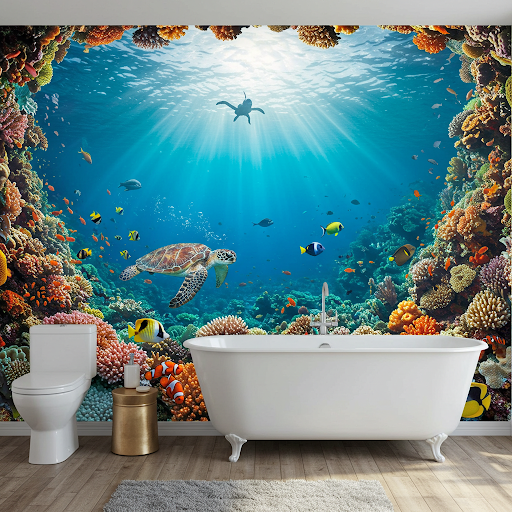
Description
Is there such a thing as 100% waterproof wallpaper? Can you wallpaper around a bathtub in a bathroom?
In the 2026 interior design landscape, the boundary between “dry” and “wet” room aesthetics has effectively vanished. Gone are the days when kitchens and bathrooms were restricted to tile and stone. With the advent of high-performance polymer coatings and advanced synthetic fibers, wallpaper murals have become a viable, high-durability alternative for even the most moisture-intensive environments.
Whether you are selecting a ready-made waterproof product or looking to “over-engineer” a bespoke mural for a splash zone, understanding the technical interaction between water vapor, substrate, and sealant is critical.
Part I: Ready-Made Waterproof Wallpaper (The 2026 Standards)
When shopping for “waterproof” wallpaper today, the industry has moved beyond simple “washable” labels. We now categorize materials based on their non-porous structure and resistance to hydrostatic pressure.
1. Solid Sheet Vinyl (Type II) Waterproof Wallpaper
This is the heavy hitter of the industry. Unlike vinyl-coated paper (which can still delaminate), Solid Sheet Vinyl consists of a vinyl layer laminated to a fabric or non-woven backing.
Why it works
The surface is completely non-porous.
Best for
Commercial-grade bathrooms and high-traffic kitchen backsplashes.
Maintenance
Can be scrubbed with abrasive cleaners without affecting the print.
2. Fiberglass-Reinforced Wallcoverings
Often called “glass textile” wallpaper, these are made from glass fibers woven into a fabric.
The 2026 Edge
Modern fiberglass murals are often pre-impregnated with hydrophobic resins.
Durability
They are fire-resistant, impact-resistant, and—most importantly—dimensionally stable. They won’t expand or contract when the shower steams up.
3. PVC-Free Polymer Murals
As sustainability becomes a priority, many manufacturers now use advanced PET (Polyethylene Terephthalate) or non-woven cellulose-polyester blends. These are finished with a high-performance UV-cured topcoat that acts as a permanent water barrier.
4. High-Tack Peel-and-Stick
While historically avoided in bathrooms, 2026-era acrylic adhesives are moisture-cured. This means they actually bond tighter in the presence of ambient humidity, preventing the “corner peel” common in older DIY products.
Part II: The Science of Sealing (Adding Layers to Standard Murals)
If you have fallen in love with a standard non-woven or paper-based mural that isn’t rated for wet areas, you can “armor” it using professional-grade sealants. This process involves creating a monolithic barrier that prevents water molecules from reaching the fibers.
The Toolkit: Essential Sealants
| Sealant Type | Finish | Best For | Technical Advantage |
| Decorators Varnish | Dead Flat / Satin | Non-woven murals | Microporous (breathable) but water-repellent. |
| Liquid Laminate | Gloss / Matte | Vinyl & Film | Flexible; won’t crack with wall movement. |
| Polyurethane (Water-Based) | Various | Paper-based murals | Extreme hardness; resistant to kitchen grease. |
| “Elephant Skin” Fluid | Matte | Intricate patterns | Ultra-thin; doesn’t obscure fine textures. |
Part III: The Multi-Layer Wallpaper Waterproofing Protocol
To transform any mural into a bathroom-ready installation, you must follow a rigid “Four-Phase” system. Failure usually occurs at the substrate level, not the surface level, so preparation is paramount.
Phase 1: Substrate Preparation (The Anti-Mold Strategy)
Waterproofing isn’t just about keeping water out; it’s about ensuring nothing gets trapped underneath.
-
Sanitization: Wipe the wall with a solution of 5% white vinegar or a specialized fungicidal wash. This kills latent mold spores.
-
The Barrier Prime: Use a high-quality Zinsser-style primer/sealer. This creates a “vapor barrier” on the drywall itself, so moisture cannot seep through the wall from the other side (common in exterior-facing bathroom walls).
-
Smoothing: Sand any imperfections. A waterproof mural is often less forgiving of “telegraphing” (bumps showing through) than standard paper.
Phase 2: Waterproof Wallpaper Adhesive Selection
In wet areas, standard wheat paste is a recipe for disaster (it’s organic and serves as food for mold).
Required
Use a Heavy Duty Clear adhesive with added fungicides.
Pro Tip
For kitchens, look for “High-Heat” rated adhesives if the mural is near an oven or stove.
Phase 3: The Critical Waterproof Wallpaper Seaming Process
90% of wallpaper failures in bathrooms start at the seams. Steam penetrates the seam, dissolves the glue, and causes curling.
-
Seam Roller: Use a hard rubber seam roller to ensure absolute contact.
-
Seam Sealer: Apply a specialized, needle-nose seam sealer (a thin, clear resin) directly into the joints before the final topcoat.
Phase 4: Applying the Protective Barrier
Once the mural has dried for at least 24 to 48 hours, you can begin the layering process.
The “Double-Layer” Technique for Maximum Protection:
For the best results, professionals often use a hybrid sheen approach.
-
The Base Coat (Satin): Apply a coat of Satin Decorators Varnish. Satin contains more resin than matte, providing a stronger initial moisture shield. Use a high-quality microfiber roller to avoid bubbles.
-
The Finish Coat (Dead Flat): If you prefer a non-reflective look, apply two coats of Dead Flat Varnish over the satin. This gives you the strength of the satin with the aesthetic of a premium matte mural.
-
Curing: Do not use the shower or stovetop for at least 5 days. The polymers need time to fully cross-link and become chemically inert.
Part IV: Room-Specific Waterproof Wallpaper Strategies
The Waterproof Kitchen: Grease vs. Water
Kitchen murals face a unique enemy: polymerized grease.
The Backsplash Zone
If your mural is behind a sink, focus on water resistance. If it is behind a hob, focus on “Scrubbability.”
The Sealant Choice
Use a cross-linking water-based polyurethane. It is more resistant to the oils and fats found in cooking vapors than standard decorators varnish.
The Waterproof Wallpaper Bathroom: Steam vs. Splashes
The “Splash Zone” (Inside the Shower)
Even “waterproof” wallpaper is rarely rated for constant immersion unless it is a fiberglass system sealed with epoxy resin. For walls inside a walk-in shower, only use fiberglass murals with a 2-part epoxy topcoat.
The “Humidity Zone” (General Bathroom Walls)
Standard vinyl or sealed non-woven is sufficient here. Ensure your ventilation fan is rated for the room’s cubic footage to prevent standing condensation.
Part V: Waterproof Wallpaper Maintenance and Longevity in 2026
A properly sealed mural in a wet area should last 7–10 years, comparable to a standard paint job.
Cleaning
Avoid “Magic Eraser” style sponges; they are micro-abrasives that will eventually strip your waterproofing layer. Use a soft microfiber cloth with a pH-neutral soap.
Inspection
Once a year, check the edges around the ceiling and baseboards. If you see any lifting, re-inject a small amount of adhesive and re-seal the edge with a brush-on varnish.
UV Protection
Modern sealants like Polyvine now include UV inhibitors. This is vital for kitchens with large windows, as it prevents the “yellowing” that used to plague old-school varnished wallpapers.
Conclusion
Waterproofing a wallpaper mural is no longer a “hack”—it is a sophisticated engineering process. By combining Type II Solid Vinyls with microporous decorators varnishes, you can achieve a finish that is aesthetically “soft” but functionally “hard.”
Whether you are installing a lush botanical jungle in a master ensuite or a geometric marble backsplash in a modern kitchen, the key remains the same: Seal the wall, seal the seam, and seal the surface. In 2026, the only limit to your kitchen or bathroom design is your imagination—not the moisture.