




Description
Evolution of African wall Mural
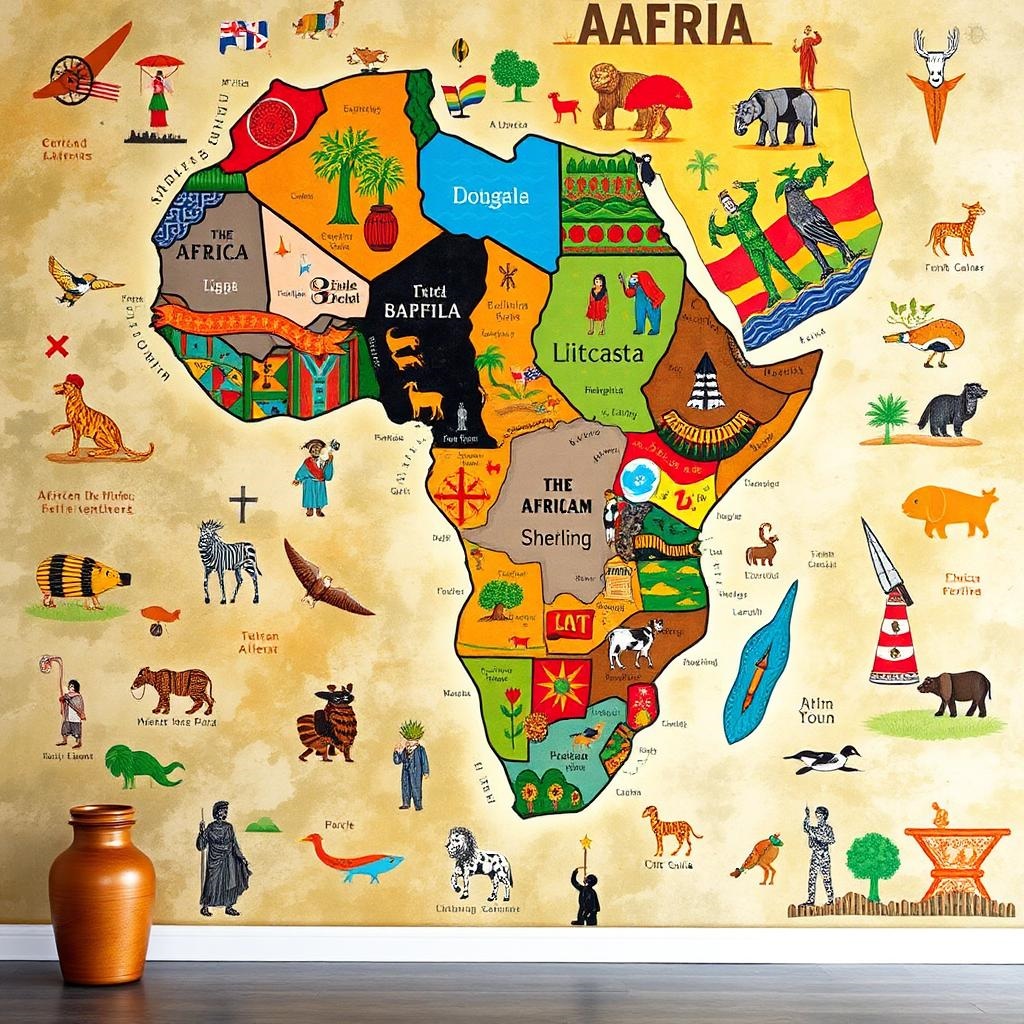
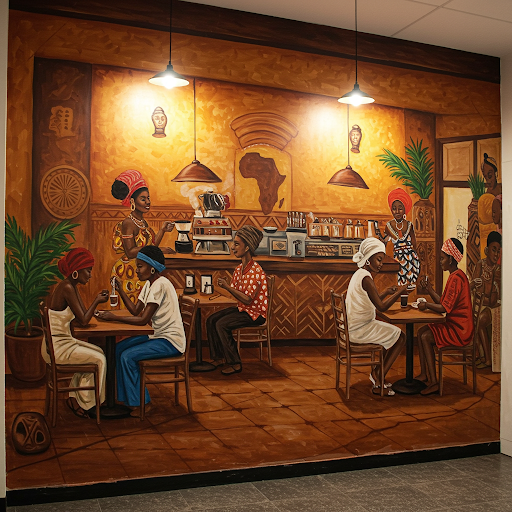
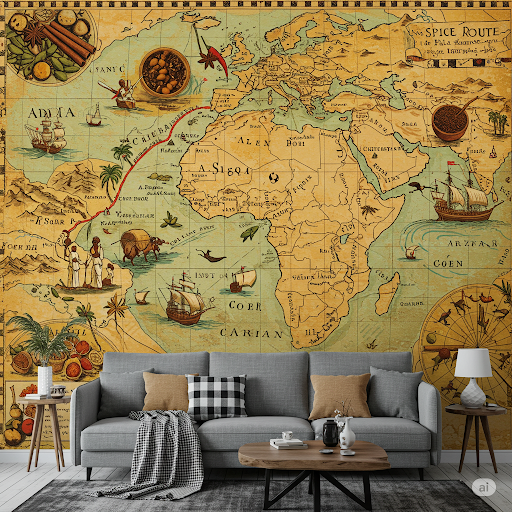
An African wall mural is a large-scale artwork applied directly to a wall (or designed to cover it completely) that originates from or is inspired by the diverse visual cultures of the African continent.
Far more than simple decoration, these murals traditionally serve as visual languages. They are historical records, spiritual conduits, and markers of social identity that have evolved from ancient rock art to contemporary urban street art and modern interior design.
Here is an overview of African wall murals, categorized by their evolution, styles, and significance.
The history of African murals spans over 30,000 years, moving through three distinct phases:
Ancient African (Rock Art)
The earliest murals were painted on cave walls and rock faces (e.g., Tassili n’Ajjer in Algeria or the Drakensberg in South Africa). These were spiritual and functional, depicting hunting scenes, trances, and climate records using ochre, charcoal, and blood.
African Traditional (Vernacular Architecture) Mural
As communities settled, the “canvas” shifted to the home. Women in varying cultures (notably in Southern and West Africa) began painting the exteriors of mud/adobe homes to signal clan identity, marital status, and to protect the home from evil spirits.
Contemporary Afrucab (Urban & Digital) Mural
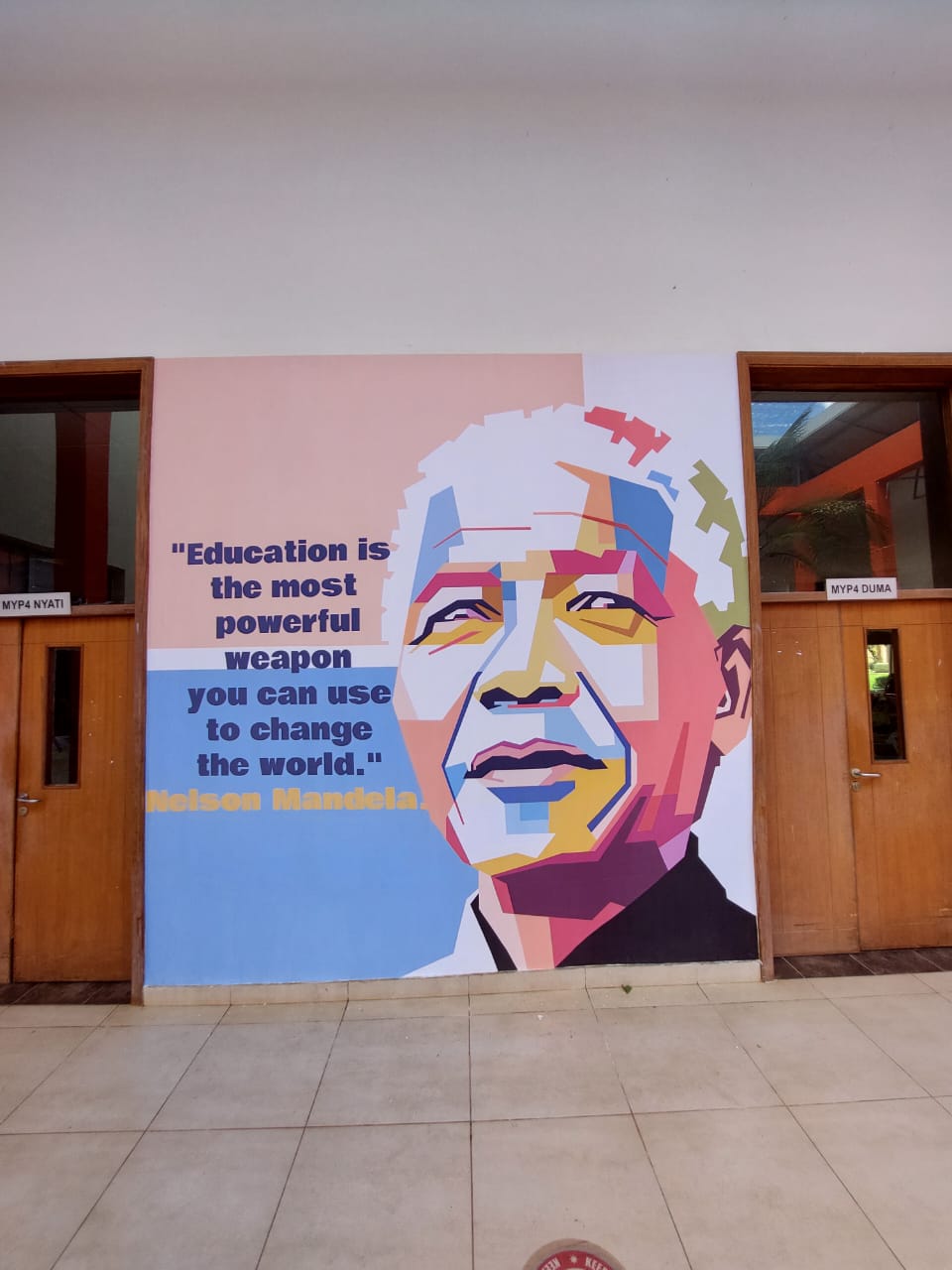
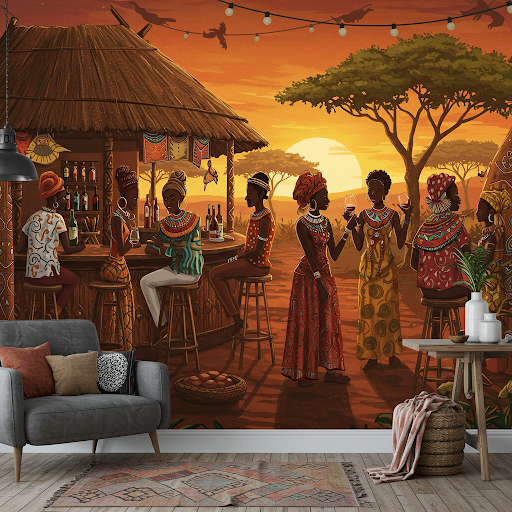
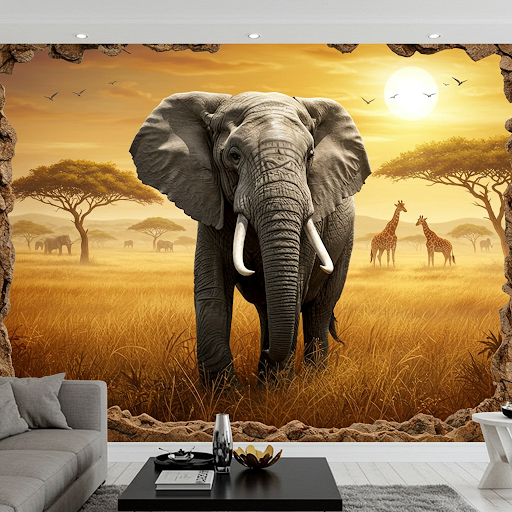
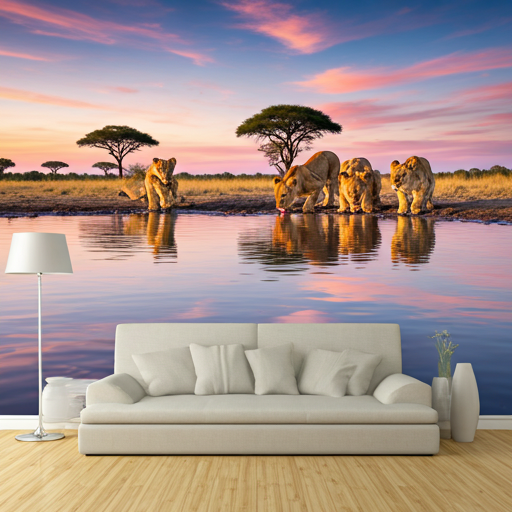
Today, African murals exist as political street art in growing metropolises (like Nairobi and Johannesburg). And as high-end digital wallpapers for interior design, blending traditional motifs with modern aesthetics (Afrofuturism).
Key Traditional African wall Mural Styles
Certain regions are globally renowned for their specific mural traditions:
Ndebele (South Africa) Mural
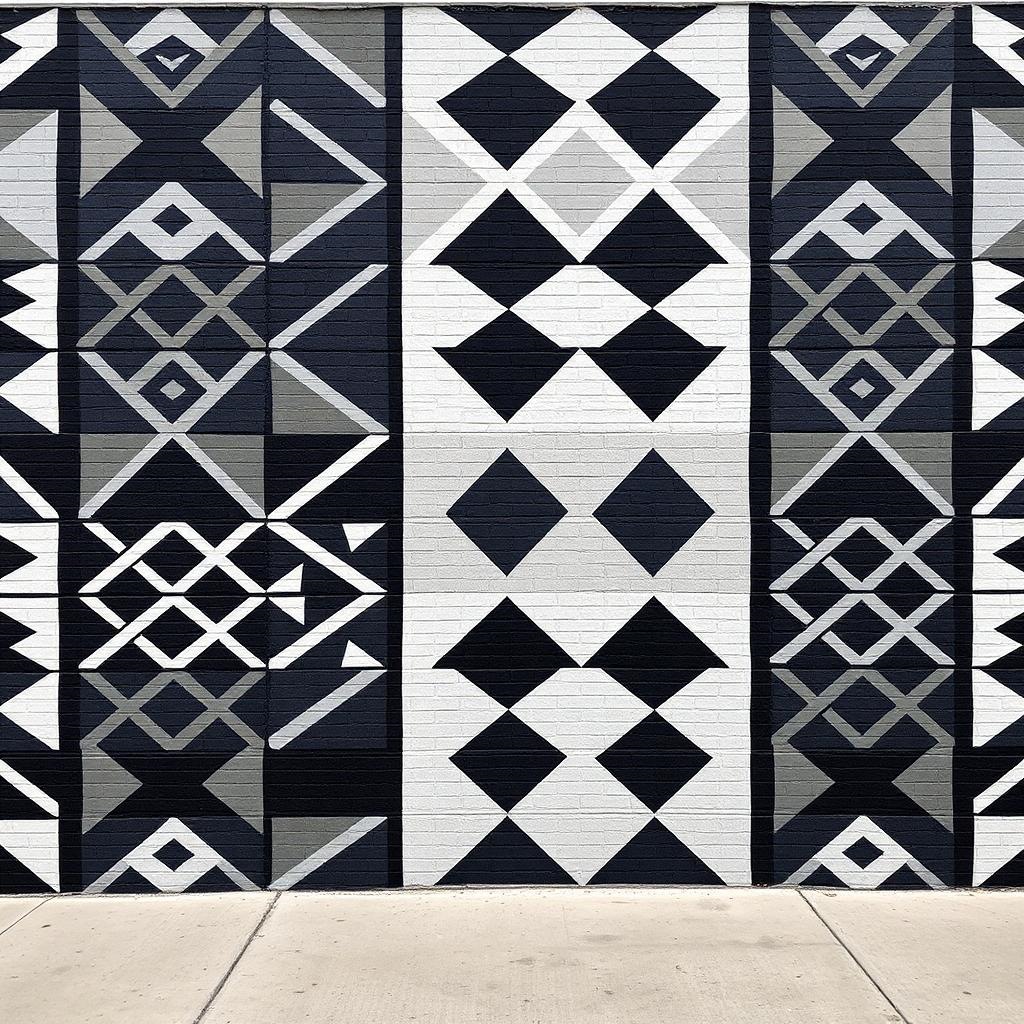
The Ndebele mural tradition is arguably the most globally recognized form of African wall mural, distinguished by its vivid, high-contrast geometric precision. Exclusively painted by women, these murals transformed the home into a canvas of resistance and identity. Originating in the 19th century as a secret method of communication during oppression by Boer settlers, the patterns encoded messages about grief, resistance, and cultural continuity that outsiders viewed merely as decoration.
While originally painted with natural earth pigments (ochre and clay), modern Ndebele art utilizes bright industrial acrylics to create bold shapes outlined in thick black lines. The complexity of the design traditionally correlates with the female artist’s status and domestic virtue, turning the homestead’s exterior into a public declaration of family pride.
Tiébélé (Burkina Faso – Kassena People) Mural
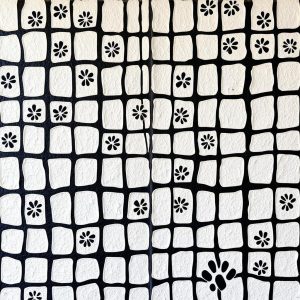
In the village of Tiébélé, the Kassena people treat their architecture as a living, decorated skin. This tradition is a communal masterpiece where women decorate the windowless earthen dwellings (sukhala) using a strict tri-color palette of black (soot or graphite), white (chalk), and red (laterite).
Far from purely ornamental, these murals serve a critical engineering function. The muralists polish the walls with smooth stones and apply a varnish made from néré pods, creating a water-resistant layer that protects the mud structure from harsh rains. The designs are rich with symbolism, featuring “fishing net” grids to symbolize sustenance and abstract crocodile motifs for protection. It is a cyclical art form, often refreshed after the harvest, reinforcing social bonds among the women who paint together.
Basotho (Lesotho) African Mural
Known locally as Litema (derived from the word for “plowed lands”), this mural tradition from Lesotho is deeply connected to the earth and agriculture. Unlike the high-contrast color of the Ndebele, Basotho murals often rely on texture and relief. Women use their fingers or combs to engrave intricate, sweeping geometric swirls and floral patterns into wet mud plaster, mimicking the furrows of a plowed field.
These designs are sometimes highlighted with natural ochres or pigments. But the play of light and shadow on the textured grooves is central to the aesthetic. Litema is inherently ephemeral. The murals are organic and typically wash away with the seasonal rains, symbolizing the cycle of nature and requiring the women to renew the artwork annually as a form of prayer for fertility and rain.
3. Common African wall Mural Themes & Symbolism
African wall murals are rarely random; they are intentional systems of communication. In many African cultures—particularly where oral tradition historically superseded written text—the wall served as a manuscript, a billboard, and a spiritual gateway all at once.
Here is a breakdown of the symbolism and themes found in African mural art, ranging from the geometric codes of the South to the philosophical symbols of the West.
Geometric Symbolism: African wall Mural Codes and Identity
In Southern and West Africa, geometry is not just aesthetic; it is often a “cipher” or a status update.
The Ndebele “Secret Code” (South Africa)
The vibrant geometric shapes of the Ndebele people are perhaps the most famous. Historically, these were not just decorations but a form of secret communication during the Boer wars and oppression.
The Razor Blade (Zig-Zag)
Often represents the hardships of life or a “barrier” that protects the home.
The Triangle
This is the primary “character” in the Ndebele alphabet.
Tip facing down
Symbolizes an unmarried man or woman.
Tip facing up
Often represents a girl or woman.
Two triangles meeting at the tips (Hourglass)
Represents a married man.
Two triangles base-to-base (Diamond)
Represents a married woman.
Lights/Windows
Small rectangles often symbolize the “light” of the ancestors watching over the home.
Kassena/Tiébélé Patterns (Burkina Faso)
The elaborate black-and-white motifs on the mud houses of the Kassena people act as “skin” for the architecture, denoting the function of the building and the status of the occupant.
Netting/Grid Patterns
Represent fishing nets, symbolizing sustenance and provision.
Broken Lines
Often represent the footprints of chickens or guinea fowl, symbolizing the path of the ancestors (who are believed to sometimes take animal form).
Braided Lines
Symbolize community cohesion and the strength of the family unit.
Visual Proverbs: Adinkra Symbols (West Africa)
In Ghana and Côte d’Ivoire, wall murals often feature Adinkra symbols. These are not just pictures but distinct philosophical concepts condensed into a logo. While originally for cloth, they are heavily used in architectural relief and modern murals.
| Symbol Name | Visual Appearance | Meaning | Mural Context |
| Gye Nyame | A spiral inside a jagged oval | “Except God” | Used to assert the supremacy of God over all life; common in entryways. |
| Sankofa | A bird looking backward | “Go back and get it” | Represents the importance of learning from the past to build the future. |
| Duafe | A wooden comb | Femininity/Beauty | Often used in women’s spaces or beauty establishments to symbolize care and hygiene. |
| Dwennimmen | Ram’s Horns | Humility & Strength | The ram is strong but fights humbly; used to represent leadership that is powerful but not arrogant. |
4. Materials and Techniques
| Era | Primary Materials | Technique |
| Traditional | Earth pigments (ochre, clay, chalk), cow dung (binding agent), and natural dyes (berries, charcoal). | Finger painting, using chicken feathers as brushes, or dragging combs through wet plaster (sgraffito). |
| Modern (Street) | Spray paint, acrylics, and industrial enamel. | Stenciling, freehand aerosol, and projection mapping. |
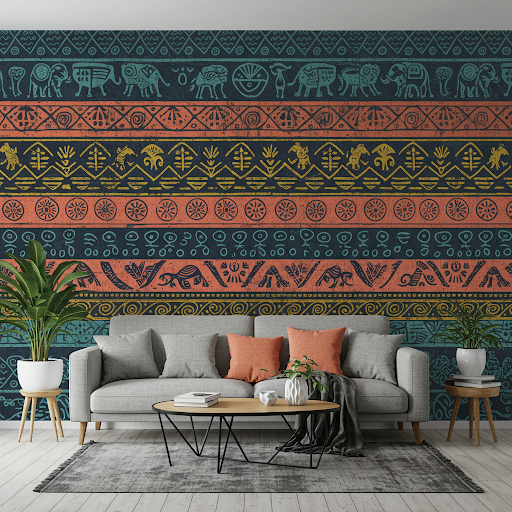
| Modern (Interior) | Vinyl, non-woven wallpaper, canvas, digital print. | High-resolution photography of textures, vector graphic design, and large-format printing. |
Contemporary African Mural Art
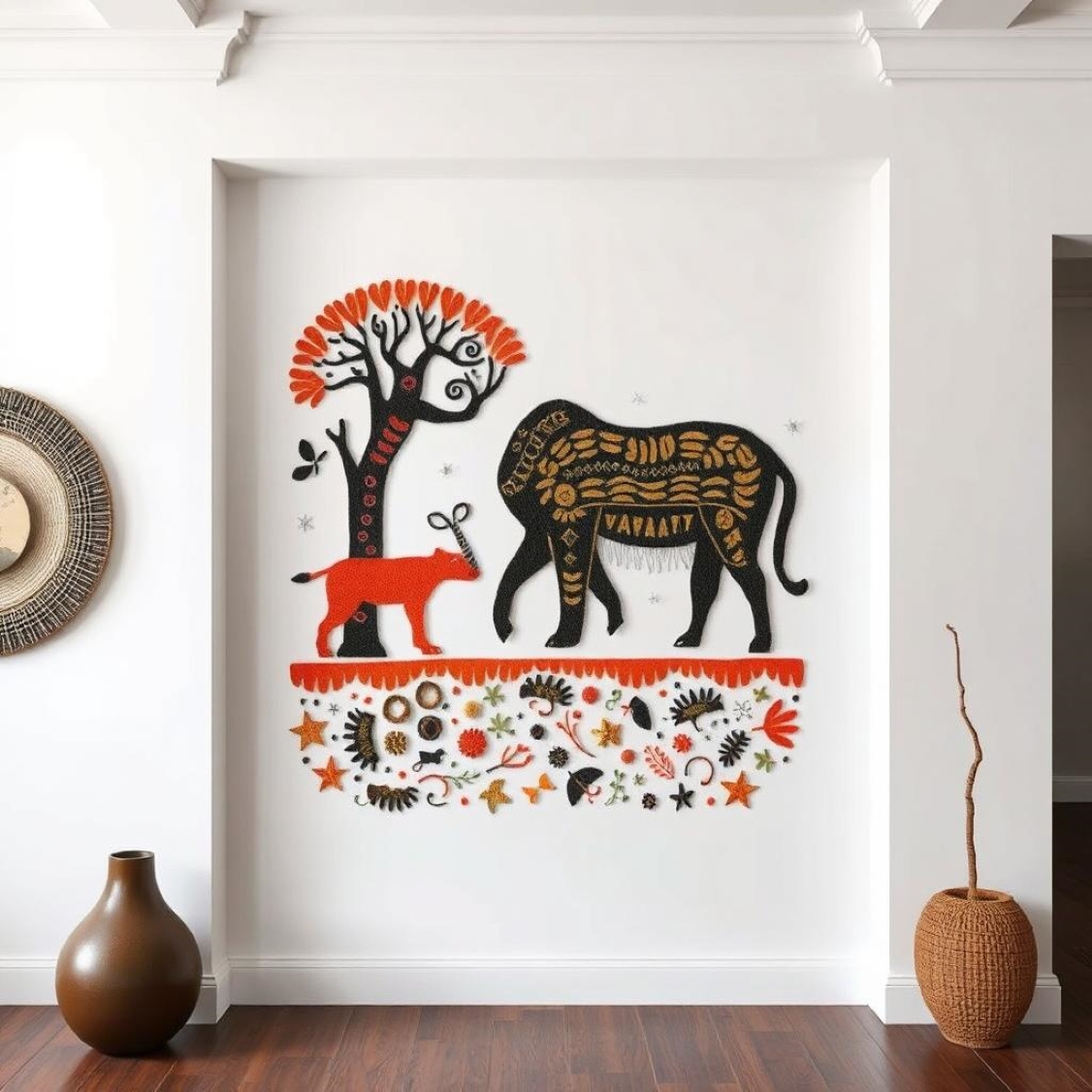
Contemporary interior decoration has moved beyond “safari” clichés into sophisticated, curated themes that treat African wall art as high-design elements. The current movement is defined by a tension between Afro-Minimalism (quiet, textural) and African Maximalism (bold, narrative).
Here are the five dominant themes in contemporary African wall art for interiors.
1. Afro-Minimalism (The Textural Wall)
This theme strips away bright colors to focus entirely on texture and silhouette. It aligns with the “Japandi” or “Organic Modern” aesthetic but uses African materials.
Key Elements:
Tonga/Binga Baskets
Handwoven baskets from Zimbabwe/Zambia arranged in large, organic clusters (clouds) on a white wall.
Mud Cloth (Bogolan)
Framed pieces of vintage Malian mud cloth, where the focus is on the handmade, imperfect geometric weave in monochrome black and white.
Juju Hats
A single, large Bamileke feather headdress (Cameroon) used as a soft, textural centerpiece above a bed or sofa.
Best For
Bedrooms, spas, and calming living spaces.
2. The New Portraiture (Black Identity & Dignity)
A powerful trend in modern offices and homes is the use of high-fashion style photography or stylized painting that celebrates the Black figure without traditional “tribal” context.
Key Elements:
High-Contrast Photography
Black and white portraits focusing on skin texture, elaborate braided hairstyles, or jewelry, often with the subject looking away or in silhouette.
Faceless Figures
Paintings that omit facial features to represent a universal African spirit, focusing instead on the movement of the body and the flow of traditional robes.
Best For
Hallways, reception areas, and statement walls.
3. Abstract Heritage (Deconstructed Geometry)
This theme takes specific tribal patterns and “remixes” them into modern abstract art. It decontextualizes the pattern so it looks like a piece of modern art first, and a cultural artifact second.
Key Elements:
Cubist Ndebele
The razor-sharp lines of South African Ndebele art, but painted in unexpected palettes like pastels or metallics (gold/bronze).
Kente Abstraction
The rhythmic blocks of Ghanaian Kente cloth, but blown up to macro scale on a canvas so they appear as large fields of color (Color Field painting).
Best For
Corporate boardrooms, dining rooms, and creative studios.
4. Eco-Sculptural (Sustainable Art)
Sustainability is a major tenet of modern African design. This theme turns recycled or natural debris into high-end wall sculpture.
Key Elements:
Repurposed Metal
Wall hangings made from flattened oil drums or recycled aluminum, often beaten into intricate lace-like patterns.
Driftwood & Cowrie Shells
Sculptures that combine weathered wood from the coast with rows of cowrie shells (a symbol of wealth and destiny).
Best For
Eco-lodges, outdoor patios, and airy lofts.
5. Afro-Luxe (The “Gold” Standard)
This is the maximalist answer to minimalism. It celebrates the wealth of the continent’s mineral resources through metallic finishes.
Key Elements:
Gilded Masks
Traditional West African masks that have been cast in bronze or painted entirely in gold leaf, mounted on velvet backdrops.
Brass Geometry
Wall sconces or sculptures made of polished brass that mimic the shape of African shields or sunbursts.
Best For
Hotel lobbies, moody lounges, and accent walls in dark rooms.