


Description
Musical Murals are large-scale artworks applied to walls—either through direct painting or digital wallpaper installation—where the central subject matter, symbolism, or aesthetic is derived from the world of music.

Functionally, it serves as the visual translation of sound. Unlike standard decorative patterns, a musical mural is narrative and atmospheric. It aims to evoke the feeling of a melody, the energy of a performance, or the history of a genre within a physical space.
Traditional Musical Murals (Classical & Realist)
The traditional musical murals are the visual embodiment of acoustic heritage. Rooted in the artistic sensibilities of the Baroque, Romantic, and Victorian eras. These designs celebrate the origins of formal music theory and the craftsmanship of orchestral instruments. Unlike modern styles that emphasize rhythm and chaos, traditional mural murals prioritize harmony, structure, and historical reverence.
Aesthetic of Realistic Musical Murals
The defining characteristic of this style is figurative realism and still life. These murals often resemble large-scale oil paintings, utilizing rich, warm palettes—deep mahoganies, burnished golds, and velvety blacks. The goal is often trompe-l’œil (trick of the eye), where the wall appears to be a three-dimensional niche housing a cello, or a shelf stacked with antique leather-bound scores.
The Musical Instruments

Focus is strictly acoustic, celebrating the instrument not just as a tool for sound, but as a masterpiece of physical craftsmanship. Imagery obsessively details the organic textures of the orchestra. The tight, straight grain of spruce on a violin’s belly, the tiger-stripe maple of the back, and the rich, glossy varnish that seems to glow under soft light. It highlights the mechanical elegance of the era. The complex, polished brass piping of a French horn, the intricate ivory and ebony interaction of a harpsichord keyboard, or the taut horsehair of a bow. These murals capture the “patina of use.” A slight wear on the fretboard or the tarnishing of silver keys, which lends the image a sense of history. And suggests that the instrument has been played by a master for decades.
The Musical Notation

Rather than the sterile, high-contrast look of modern digital print, backgrounds in this style feature the warmth of historical manuscripts. The imagery utilizes the aesthetic of aged parchment. Paper that is yellowed, textured, and perhaps slightly frayed at the edges (foxing). And the musical notation is often depicted as hand-penned calligraphy. With ink density varying on the stems of notes and the curls of the treble clef, emphasizing the human hand behind the composition. Common motifs include excerpts from the great masters. Like Bach’s fugues, Beethoven’s sonatas, or Mozart’s concertos—serving as a visual “language” of genius. This layer adds intellectual depth to the wall. It is not just decoration, but a representation of the complex mathematical and emotional structure that underpins classical music theory.
The Musical Setting
To ground the instruments, the scenes are often placed within romanticized, architectural environments that play with light and shadow (chiaroscuro). The setting might depict the dust-mote-filled silence of a luthier’s workshop, surrounded by wood shavings and tools. Or the grandeur of a 19th-century opera house with heavy red velvet curtains and gold-leaf trim.
Alternatively, the mural might evoke the intimacy of a private practice room, illuminated by the single, warm flame of a candlestick next to a mechanical metronome. These backgrounds are crucial for establishing mood. They provide a context of solitude and dedication, suggesting a moment of pause before the performance begins. And inviting the viewer to step into a world of quietude and focus.
Musical Atmosphere and Application
Functionally, these musical murals create an atmosphere of silence, focus, and sophistication. They are the antithesis of “noise.” Because of this, they are uniquely suited for spaces requiring gravitas and calm. Such as home libraries, formal dining rooms, music conservatories, or law office lobbies. They transform a wall into a window into the past, suggesting that the occupant values history, discipline, and the timeless beauty of the classics.
Modern Musical Murals (Stylized & Cultural)
The Modern musical murals represent the dynamic cultural explosion of the 20th century. Departing from the strict, silent realism of traditional classical designs. They shift the focus from the instrument itself to the energy, rhythm, and lifestyle of the musician. This modern era encompasses the visual languages of Art Deco, Cubism, Mid-Century Modern, and Pop Art. They cover the golden ages of Jazz, Blues, Rock ‘n’ Roll, and Soul. These murals are not passive backgrounds. They are active participants in the room’s design, mirroring the syncopation of jazz or the rebellion of rock. And celebrate the era when music became amplified, visualized, and democratized, moving from the elite conservatory to the public dance hall and the radio airwaves.
The Aesthetic of Musical Interpretation

Unlike traditional murals that act like mirrors reflecting reality, modern murals act like prisms, refracting reality into art.
Cubism and Geometrical Murals
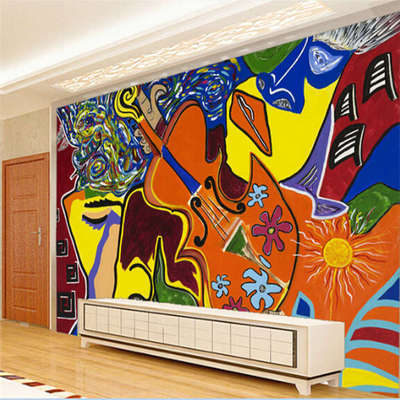
Inspired by the revolutionary works of artists like Picasso, Braque, and Gris, these designs often “break” instruments into fractured, geometric shards to visually represent the syncopated rhythms of Jazz and the “organized chaos” of improvisation.
A saxophone is no longer just a brass tube. It becomes a collection of gold triangles and sharp angles that seem to vibrate on the wall. A guitar might be deconstructed into a series of intersecting curves and planes, challenging the viewer’s perspective. This style uses geometry to mimic the complexity of a musical score. Overlapping shapes represent overlapping notes, and sharp lines represent staccato beats. The color palette often uses earthy terracottas, deep blues, and mustard yellows, creating a mural that feels intellectual, dynamic, and kinetic. Perfectly suited for spaces where music is analyzed and appreciated.
Pop Art Musical Wallpaper
Drawing from the commercial boom of the 1960s and artists like Andy Warhol and Roy Lichtenstein, these murals utilize flat, bold colors and repetitive imagery to celebrate the objects of music consumption. The look is graphic, poster-like, and intentionally two-dimensional. They often employ “Ben-Day dots” (comic book texture) or high-contrast outlines. Common subjects include a grid of neon-colored cassette tapes, a stylized close-up of a Shure 55SH microphone, or a spinning vinyl record rendered in electric blue and hot pink. This style strips away the seriousness of high art and replaces it with fun, irony, and vibrancy. It transforms the wall into a giant gig poster or an album cover. This makes it an ideal choice for a lively entertainment room or a retro-themed space that doesn’t take itself too seriously.
Cultural Nostalgia and Musical Iconography

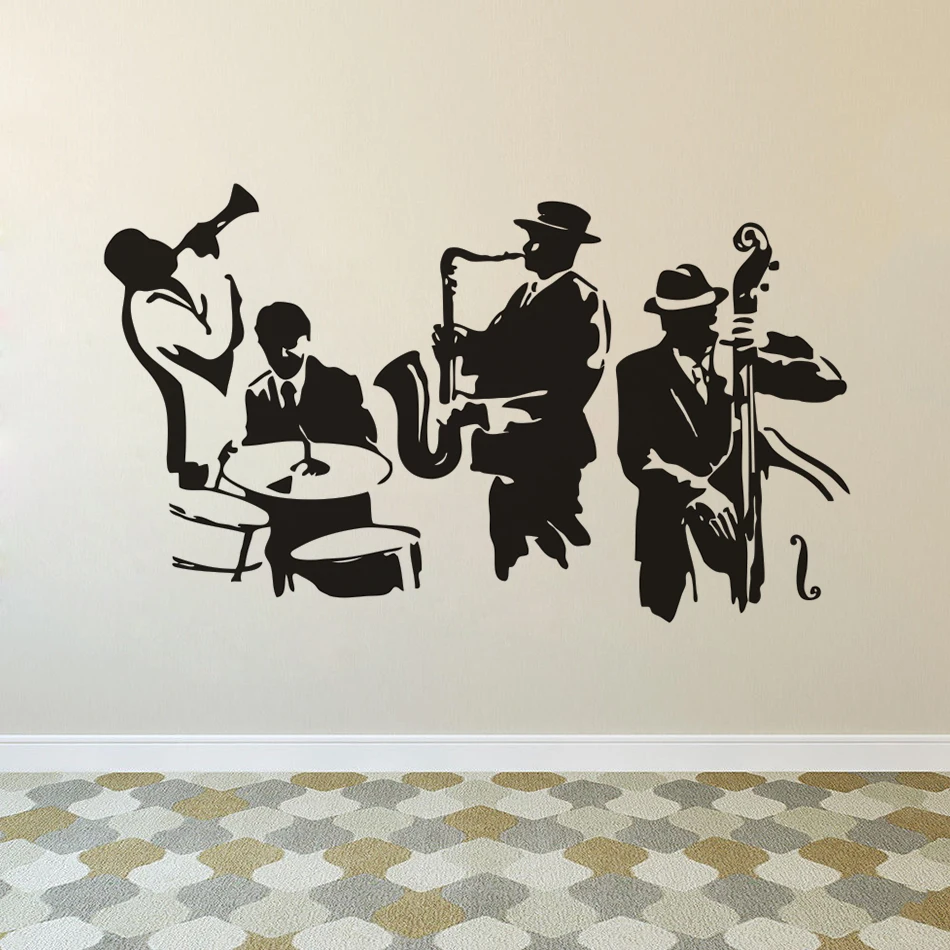
These murals are heavily narrative, telling the story of specific subcultures and transporting the viewer to a cinematic past. They trade the pristine opera house for the gritty, atmospheric smoky basement club. Common imagery includes the sleek, elongated silhouettes of a swing band in mid-performance, the glowing neon signage of a Motown revue, or the leather-and-chrome “greaser” aesthetic of 1950s Rock ‘n’ Roll. The focus is often on the human element—the silhouette of a trumpeter leaning back in passion, the sway of a flapper dancer, or the collective movement of a crowd. By capturing the “cool” factor—the sweat, the smoke, and the style—that classical music often omits, these murals provide a backdrop that feels lived-in, soulful, and deeply atmospheric.
Musical Atmosphere and Application
Functionally, modern music murals inject a space with rhythm and personality. They are nostalgic without being stuffy or overly formal. And they are best suited for social spaces where conversation and music happen simultaneously: cocktail lounges, retro-themed diners, creative agency breakrooms, or a home entertainment area. They set a mood that is loose, artistic, and culturally rich, inviting guests to relax and enjoy the vibe.
Contemporary Musical Murals (Digital, Urban & Conceptual)

The contemporary musical murals represent the cutting edge of visual audio. They reject the sepia-toned nostalgia of the past in favor of the immediate “now.” This category leverages the power of the Digital Age—high-resolution photography, computer-generated imagery (CGI), and AI—to explore the physics of sound and the raw reality of the street.
The Aesthetic of the Hyper-Real and the Invisible
One dominant strand of this style is Macro Photorealism. By magnifying an object to 100x its size, these murals transform microscopic details into architectural features. A single guitar string becomes a coiled metallic cable; the dust on a vinyl record becomes a texture map; the reflection in a saxophone bell becomes a distorted mirror. This creates a sensory, almost tactile experience where the viewer feels small inside the instrument.
Conversely, the Digital & Glitch sub-genre visualizes what cannot be seen: audio frequencies. Using neon EQ bars, floating waveforms, and “glitch art” (visual distortions that mimic electronic interference), these designs appeal to the producer mindset. They represent the machinery of music—the synthesizer, the mixing board, and the software.
Urban Rawness Musical Wallpaper
Finally, contemporary design embraces the Urban aesthetics of Hip Hop and DJ culture. These murals do not just depict music; they embody the rebellious spirit of the street where the genre was born. This style mimics the chaotic energy of graffiti art, utilizing visual tropes like aerosol spray textures, dripping ink, and layered stencils to create a look that feels raw and unpolished.
Common imagery includes hyper-stylized boomboxes, turntables, and breakdancers, often interwoven with bold, illegible “wildstyle” typography or tags. The color palette is often aggressive—neon greens, hot pinks, and stark blacks against concrete grey backgrounds. By bringing the “grit” of the city indoors, these murals reject the refined polish of traditional interior design in favor of authenticity and attitude. They are perfect for creative studios, game rooms, or any space that wants to signal a connection to youth culture and the underground scene.
Atmosphere and Application
Functionally, these murals are immersive and stimulating. They are designed to create intensity rather than relaxation. This makes them the definitive choice for high-energy environments: professional recording studios, tech startup lounges, modern gyms, or “man caves” centered around gaming and high-fidelity audio. They signal that the space is wired, current, and loud.
Summary Comparison
| Feature | Traditional | Modern | Contemporary |
| Focus | Orchestra / Composer | Band / Icon | Sound / Technology |
| Style | Realistic / Painterly | Stylized / Geometric / Pop | Photorealistic / Digital / Abstract |
| Mood | Elegant, Serene | Cool, Nostalgic, Rhythmic | Immersive, Raw, High-Tech |
| Key Era | 1700s – 1900 | 1920s – 1980s | 1990s – Present |
Artificial Intelligence and Computer-Generated Musical Murals

Artificial Intelligence (AI) and Computer-Generated Imagery (CGI) have revolutionized the concept of the musical mural, moving the medium from representation to pure imagination. Unlike photography, which captures what exists, or illustration, which is limited by the human hand, AI and CGI generate visuals that are physically impossible, creating “dreamscapes” of sound.
The Aesthetic of Synesthesia
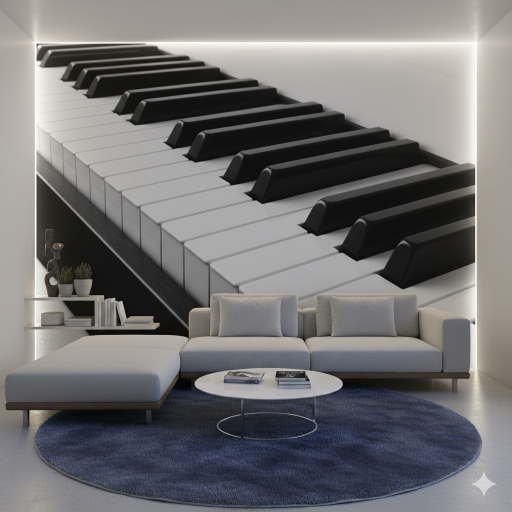
The most defining characteristic of this style is the visualization of synesthesia. The neurological condition where hearing triggers the visualization of color. AI algorithms can be prompted to “paint a jazz saxophone solo in the style of a nebula,” resulting in swirling, ethereal smoke that solidifies into brass instruments. These murals often feature “impossible instruments.” Pianos that melt into waterfalls, or violins composed entirely of fiber-optic light. This creates a surreal, hypnotic focal point that captures the emotional experience of music rather than just the physical tools.
Infinite Resolution and Fractal Geometry
From a technical standpoint, computer-generated musical murals solve the issue of scale. Using vector-based fractal algorithms, these designs can be scaled to cover the side of a ten-story building without losing a single pixel of clarity. This style often utilizes fractal geometry to represent the mathematical precision of music theory. And can create complex, repeating patterns of musical notes or strings that draw the viewer in.
The Cybernetic Musical Murals
For a more aggressive look, CGI is used to create “Cyberpunk” music murals. These feature hyper-realistic 3D renders of futuristic instruments—chrome speakers floating in zero gravity, or mixing boards that look like spaceship controls. This style is perfect for modern tech offices or electronic music studios, signaling a fusion of humanity’s oldest art form (music) with its newest technology (AI).