


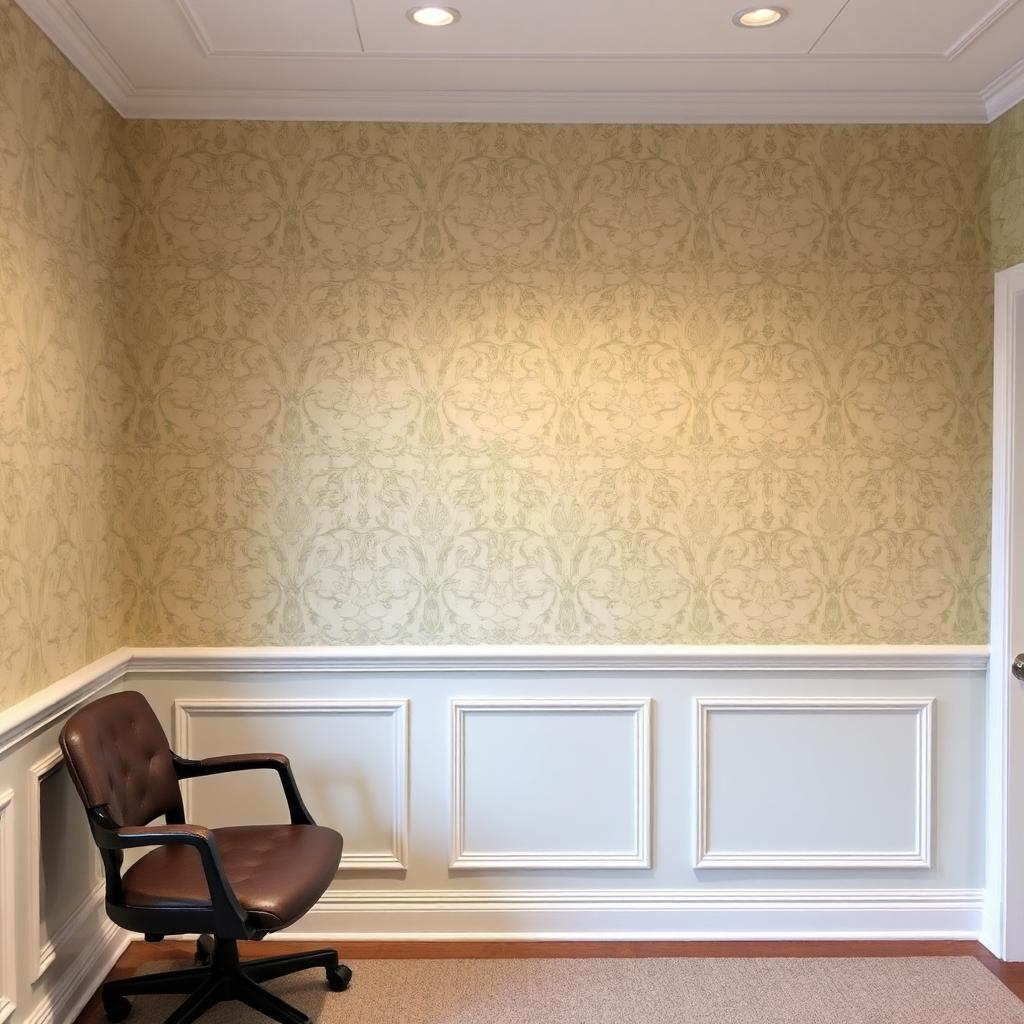
Description
Trompe l’oeil Wainscoting Wallpaper (pronounced tromp-loy) is a French term meaning “deceive the eye.” It refers to an art technique that uses highly realistic imagery to create the optical illusion that depicted objects exist in three dimensions. And in this case, wallpaper that looks like wainscoting.
Trompe l’oeil Wainscot Wallpaper is a specialized wall covering that utilizes high-definition digital printing and artistic rendering to simulate the appearance of traditional wooden wainscoting (architectural paneling) on a perfectly flat surface. It is designed to “fool” a viewer into believing a wall has physical depth, shadows, and millwork that it does not actually possess.
Below is an overview of its advantages and disadvantages to help you decide if it’s the right fit for your space.
Advantages of Trompe l’oeil Wainscoting Wallpaper
Cost-Effective Grandeur
Real wainscoting requires expensive materials (solid wood or MDF), specialized tools, and often professional labor. A mural achieves a similar “stately” aesthetic for a fraction of the price.
Space-Saving Wallpaper
Real wood wainscoting typically ranges from 1.2 cm to 2.5 cm in thickness. Standard tongue-and-groove planks or Shaker-style stiles usually measure 1.5 cm to 1.9 cm. When adding decorative top caps or chair rails, the total protrusion from the wall can reach 3 cm to 5 cm. In narrow hallways or small powder rooms, wallpaper provides the look of texture without sacrificing any floor space.
Wallpaper Ease of Installation & Removal
Unlike permanent wood panels that require nails or heavy construction adhesive (which can ruin drywall), murals come in easy-paste options. This makes them ideal for renters or homeowners who like to change their decor frequently.
Architectural Correction
If your room is a “plain box” with no character, trompe l’oeil wainscoting adds instant architectural interest. It can also “ground” a room by visually lowering the ceiling or creating a balanced horizontal line.
Wallpaper Conceals Wall Imperfections
Busy patterns or dark “faux wood” textures are excellent at hiding minor bumps, scratches, or unevenness in the underlying drywall.
Disadvantages of Wallpaper
Vantage Point Sensitivity
The “3D effect” is often most convincing from a specific distance or angle. Up close, or from a sharp side angle, the illusion can “collapse,” revealing that the surface is flat.
Lack of Physical Protection
Real wainscoting was historically used to protect walls from chair scuffs and foot traffic. Wallpaper provides almost no physical protection against impacts, furniture dings, or pets.
Wallpaper Application
To maintain the illusion, the wallpaper must be aligned perfectly. Even a $1/8$-inch misalignment at the seams will break the continuous “line” of the faux molding, immediately ruining the effect.
Trompe l’oeil Wainscoting Wallpaper Designs
Trompe l’oeil wainscoting murals fall into three stylistic categories. Each category serves a different architectural purpose. While they all “trick the eye,” they do so by mimicking different materials and historical eras.
1. Traditional Natural Wood Trompe l’oeil Wainscoting Wallpaper
Traditional natural wood trompe l’oeil murals focus on organic realism, transforming sterile walls into high-end architectural features. Here are the visual elements, styles, and the mechanical “trick” that makes them effective.
Visual Elements
To replicate the warmth of real timber, these murals use ultra-high-definition scans of premium hardwoods like Oak, Walnut, Mahogany, or Cherry. The designs emphasize organic “flaws”—such as knots, mineral streaks, and varying grain directions—to prevent the pattern from looking artificial. Subtle digital gradients mimic the semi-gloss sheen of a hand-rubbed varnish, giving the flat paper a perceived “glow.”
Common Styles
The most prevalent styles include Victorian raised panels, characterized by deep beveled edges and “shadowed” moldings that suggest grand history. For a more scholarly feel, dark English library mahogany designs feature rich, reddish-brown tones and intricate “carved” details. Conversely, rustic reclaimed barn wood styles utilize weathered textures and gray-wash finishes to provide a tactile, farmhouse aesthetic without the splinters.
The “Trick”
The illusion relies on chiaroscuro—the intentional contrast between light and dark. Digital artists bake “fixed shadows” into the print, placing them exactly where a real wooden lip would cast a shadow onto a recessed panel. By aligning the wood grain to flow vertically on stiles and horizontally on rails, the mural mimics how a carpenter would construct real wainscoting, tricking the brain into perceiving physical weight and structural joinery.
2. Painted Millwork (Architectural White/Neutral)
This is the most popular category for modern homes, designed to look like custom carpentry that has been professionally painted.
Visual Elements
Instead of wood grain, the focus here is on clean lines and shadows. These murals usually come in shades of white, cream, “off-black,” or sage green. They mimic the look of eggshell or satin paint finishes.
Common Trompe l’oeil Wainscoting Wallpaper Styles
When selecting a Trompe l’oeil wainscoting wallpaper, the design you choose dictates the entire architectural “language” of your room. These styles use specific digital shading techniques to mimic different historical and modern construction methods.
Shaker Style
Shaker-style wallpaper mimics the clean, functionalist woodwork of the 18th-century Shaker community. It features simple, recessed rectangular panels defined by straight edges and flat “stiles” (vertical pieces) and “rails” (horizontal pieces).
Board and Batten
This style replicates verticality and rhythm. In real life, it consists of wide boards joined by narrow strips (battens). As a mural, the “shadows” are focused on the long vertical lines, which draws the eye upward and makes a ceiling feel significantly taller.
Boiserie
Derived from the French word for “woodwork,” Boiserie murals mimic the lavish, hand-carved panels of 17th-century Parisian mansions. These designs feature intricate filigree, curved molding “corner” details, and sometimes gilded (gold) leaf highlights.
The “Trick”
The success of this style depends on the shading of the “recess.” The artist uses “cool” greys for shadows and “warm” whites for the highlights to make the panels look like they are stepping back into the wall.
3. Grisaille & Relief (Monochromatic Stone/Plaster)
This is a more artistic and classical approach. “Grisaille” comes from the French word gris (grey) and refers to a method of painting executed entirely in shades of grey or another neutral scale.
Visual Elements
These murals do not try to look like wood; instead, they mimic carved stone, marble, or molded plaster. They often feature “relief” designs, such as lions’ heads, floral swags, or neoclassical rosettes.
Common Styles
Neoclassical stone panels, “Plaster of Paris” moldings, and Baroque stone carvings.
The “Trick”
This style uses extreme contrast. Because there is no color to distract the eye, the brain focuses entirely on the tonal values. It creates a “museum” or “palace” aesthetic, making a flat wall look like it was hand-carved by a stonemason.
Trompe l’oeil Wainscoting Wallpaper or Wainscot with wallpaper?
Trompe l’oeil Wainscoting Wallpaper is a single, flat mural that visually mimics 3D wood panels through printed shadows. Wainscot with wallpaper refers to two distinct layers: physical wood or MDF paneling on the lower wall, topped with actual decorative wallpaper above a chair rail, creating real depth and texture.
Wainscot and wallpaper mural describes a high-impact design technique where two distinct decorative layers are combined: physical architectural paneling on the lower portion of the wall and a large-scale artistic mural on the upper portion.
Unlike traditional repeating wallpaper, a mural acts as a singular, non-repeating piece of art, making this combination a favorite for creating a “storytelling” or “immersive” atmosphere in a room.
The Trompe l’oeil Wainscoting Wallpaper with Mural Formula
The Trompe l’oeil Wainscoting Wallpaper with Mural Formula is a masterclass in architectural balance. By splitting the wall into two distinct zones, you create a room that feels both physically grounded and visually expansive.
The One-Third to Two-Thirds Rule
This classic design ratio creates a harmonious aesthetic that mimics the proportions found in nature and classical architecture.
Lower Section: The Anchor
The bottom 32–36 inches of the wall serves as the “foundation.” Whether using physical wood or a hyper-realistic Trompe l’oeil print, this section provides visual “weight.” It mimics structural elements like Raised Panels for formality, Shaker for modern simplicity, or Beadboard for a relaxed, cottage feel. This lower third defines the room’s perimeter and creates a protective-looking barrier that makes the space feel secure and finished.
Upper Section: The Window
The remaining two-thirds of the wall—extending from the chair rail to the ceiling—serves as the “emotional” heart of the room. A wallpaper mural here acts as a virtual window, dissolving the boundary of the wall. Because it sits above the eye level of most furniture, the mural remains unobstructed, allowing expansive scenes like misty forests, panoramic landscapes, or ethereal abstracts to breathe and transport the viewer.
The Synthesis
The magic of this formula lies in the transition. The horizontal line of the chair rail (whether real or printed) acts as a horizon line. This separation prevents the mural from feeling cluttered and ensures the wainscoting doesn’t feel monotonous. Together, they turn a flat drywall surface into a multi-dimensional architectural experience.
Why This Combination Works
Visual Balance
The rigid, geometric lines of wainscoting provide a “frame” that prevents a large, busy mural from overwhelming the room.
Enhanced Height
By placing the mural on the top two-thirds of the wall, the eye is naturally drawn upward, creating the illusion of taller ceilings.
Practicality
The wainscoting protects the wall from chair scuffs and fingerprints in high-traffic areas (like dining rooms or hallways), while the more delicate mural remains out of reach of damage.
Cost Efficiency
Using a mural only on the top half of a wall requires less material than a full-wall installation, making high-end designer murals more affordable.
Popular Style Pairings
Pairing physical wainscoting with a wallpaper mural is a design strategy used to create balance.1 The rigid, geometric lines of the paneling “anchor” the room, allowing the expansive, often busy mural above to act as a focused piece of art rather than an overwhelming pattern.2
As we look toward 2025 interior trends, five specific pairings have emerged as the most effective for creating a cohesive atmosphere.
1. The “Chinoiserie Chic” (Ornate Boiserie + Floral Mural)3
This is the pinnacle of maximalist elegance. It pairs highly detailed, French-style Boiserie (curved or decorative moldings) with a Chinoiserie mural featuring birds, butterflies, and sprawling botanical branches.
The Vibe
High-end Regency, romantic, and storied.
Design Tip
Paint the wainscoting in a “muted jewel tone” pulled from the mural—such as a dusty rose or sage green—to make the transition feel intentional.
2. The “Modern Sanctuary” (Shaker Paneling + Misty Landscape)
A favorite for bedrooms and nurseries, this pairing uses clean, minimalist Shaker-style panels to ground a soft, atmospheric landscape mural (misty forests, rolling hills, or calm shorelines).
The Vibe
Zen, airy, and calming.
Design Tip
Use “Green as the New Neutral.” An olive or eucalyptus green wainscot paired with a foggy forest mural is a top trend for 2025, bringing the “biophilic” (nature-connected) outdoors inside.
3. The “Dark Academia” (Dark Oak + Vintage Map or Library)
This style uses heavy, traditional wood-stained wainscoting (Oak or Walnut) topped with a vintage-style mural, such as a 19th-century world map, an etching of a European city, or a “trompe l’oeil” bookshelf.
The Vibe
Intellectual, moody, and historical.
Design Tip
This pairing works best in small spaces like home offices or “hidden” powder rooms where the dark colors create a cozy, cocoon-like effect.
4. The “Coastal Cottage” (Beadboard + Seascape Mural)
Vertical Beadboard wainscoting provides a rhythmic, textural base that perfectly complements a seascape mural featuring dunes, soft waves, or nautical horizons.
The Vibe
Breezy, casual, and nostalgic.
Design Tip
Keep the wainscoting a crisp, “Almond” or “Soft Nude” white rather than a stark refrigerator white. This matches the 2025 trend toward warmer, “sun-baked” neutrals.
5. The “Industrial Loft” (Flat-Panel Black + Abstract Geometric)
For a contemporary edge, use sleek, flat-panel wainscoting painted in a matte black or charcoal, paired with a large-scale abstract mural featuring bold strokes or geometric shapes.
The Vibe
Sophisticated, artistic, and masculine.
Design Tip
Treat the chair rail as a “frame.” Use a thin, metallic trim (like brass or chrome) between the black paneling and the mural to add a touch of luxury.
Style Pairing Cheat Sheet
| Room Type | Best Wainscot | Best Mural Style | 2025 Trend Color |
| Dining Room | Raised Panel | Chinoiserie / Botanical | Dusty Terracotta |
| Bedroom | Shaker | Misty Landscape | Sage Green |
| Hallway | Board & Batten | Abstract / Geometric | Sandy Beige |
| Library | Reclaimed Wood | Vintage Map / Etching | Deep Navy / Plum |