


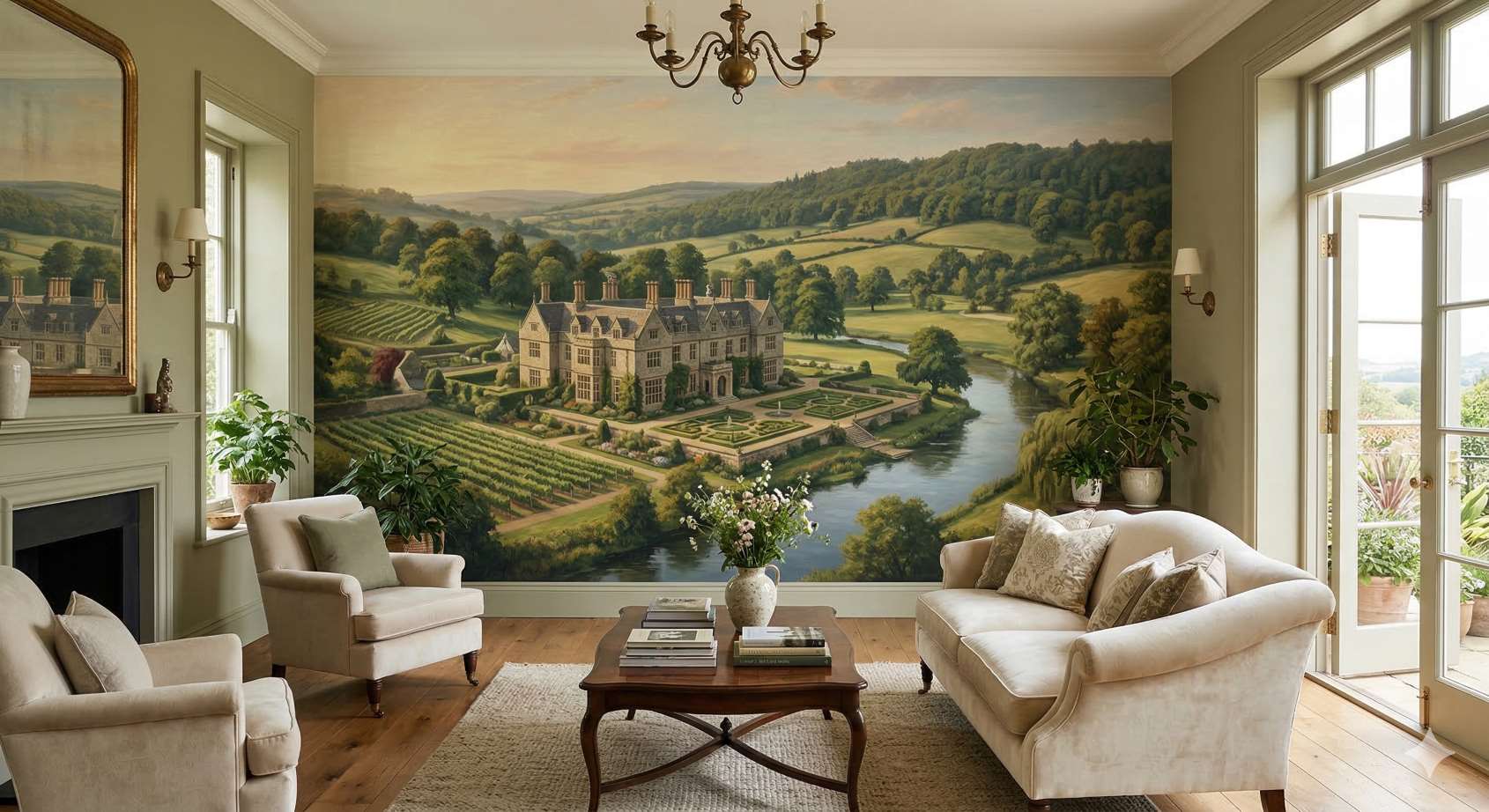
Description
What Defines an Estate Wallpaper Mural?
In luxury real estate, estate wallpaper murals function as permanent architectural assets rather than mere decor. These hand-painted, site-specific installations—often costing tens of thousands—elevate a property’s “cost basis” and marketability. By transforming walls into high-value gallery art, they create “memory anchors” for buyers, justifying premium asking prices through a blend of historical prestige and bespoke craftsmanship.
Estate wallpaper murals are a sophisticated step up from standard repetitive patterns. They are designed to transform an entire wall into a single, cohesive work of art, often evoking a sense of grandeur, history, or immersive nature.
Think of them less like “wallpaper” and more like a custom-fit gallery piece for your home.
Unlike traditional wallpaper rolls that repeat a pattern every 20 or 50 centimeters, estate murals are non-repeating. They are typically sold as a single seamless sheet or a complete set of panels that, when combined, create one large-scale image.
1. Common Estate Wallpaper Themes and Styles
Chinoiserie
Chinoiserie remains the gold standard of estate luxury, blending European fantasy with Eastern artistry. These murals typically feature sprawling, hand-painted scenes of exotic birds, delicate cherry blossoms, and ornate garden pavilions. Brands like de Gournay and Gracie utilize traditional silk backings, creating a shimmering, layered depth that transforms a room into a serene, high-status sanctuary of timeless elegance.
Etched Landscapes
Drawing inspiration from 18th-century copperplate engravings, etched landscapes offer a sophisticated, archival aesthetic. Often rendered in monochrome or sepia, these murals depict sweeping vistas, classical ruins, or pastoral vignettes reminiscent of Toile de Jouy. Their fine-line detail provides a scholarly, “old-world” atmosphere, functioning as a subtle, panoramic backdrop that adds immense architectural character without overwhelming contemporary furniture.
Botanical & Verdure
Botanical and Verdure murals bring the “outside in” through lush, oversized depictions of tropical flora or dense European forests. Unlike small floral prints, these estate-scale designs use deep greens and earthy tones to create an immersive, conservatory-like feel. They provide a sense of organic growth and vitality, making them ideal for high-ceilinged spaces where nature serves as the primary art.
Abstract Textures
Abstract texture murals focus on the interplay of color and movement rather than literal imagery. These designs often mimic large-scale watercolor washes, dramatic marble veining, or oxidized metallic patinas. By treating the wall as a giant canvas of texture, they provide a modern, architectural alternative to traditional murals, offering a moody, sophisticated “vibe” that enhances the room’s structural geometry.
2. Estate Wallpaper Material Options
Why Choose Estate Wallpaper Mural
Architectural Correction
A mural with a “distant landscape” can make a small, windowless room feel significantly larger by adding perceived depth.
The “Hero” Factor
It eliminates the need for expensive artwork. The wall is the art.
Customization
Many estate-grade murals are “scaled to fit,” meaning the company adjusts the design so that a tree branch or a mountain peak isn’t cut off by your specific door or window.
Key Considerations Before Buying
Measure Twice, Order Once: Because these are non-repeating, you cannot simply buy an extra roll later if you run short. You must have the exact dimensions of your wall, including any “bleed” (extra 2–5cm) for trimming.
Wall Prep
Murals are often thinner or more delicate than heavy-duty vinyl. The wall underneath must be smooth, primed, and free of bumps, or every imperfection will show through.
Lighting
Large-scale murals can drastically change the light in a room. A dark forest mural will absorb light, while a pale Chinoiserie silk will reflect it.
The Focal Point
Consider where your furniture will sit. You don’t want to spend $1,000 on a mural only to hide the best part of the illustration behind a tall headboard or a bookshelf.
Would you like me to help you narrow down a specific style based on your current furniture, or perhaps find a few reputable brands that fit your budget?
Estate Wallpaper in Real Estate
While they share the word “estate,” the relationship is more about historical status and market perception than a direct technical link.
Here is how the two worlds intersect:
1. The Historical “Estate” Link
Historically, “Estate Wallpapers” (specifically scenic or panoramic murals) were a marker of extreme wealth. In the 18th and 19th centuries, these murals were hand-painted or block-printed in France and exported to the grand estates of Europe and the American Colonies.
A Sign of Travel
In an era before photography, having a panoramic mural of the Swiss Alps or the harbor of Canton on your walls proved you were a person of “estate”—meaning you had the worldly knowledge and the land-owning status to afford such luxury.
Architectural Integration
These murals were often designed specifically for the dimensions of a particular room in a manor house, making them a permanent part of the building’s “real estate” rather than a decorative afterthought.
2. Impact of Estate Wallpaper on Property Value
In the world of ultra-high-end real estate, an estate wallpaper mural isn’t just “decoration”—it is often categorized as a fixed asset or a permanent architectural finish.
To expound on why these murals are treated like marble or custom millwork rather than simple wallpaper, we have to look at the intersection of craftsmanship, tax law, and appraisal logic.
1. The “Bespoke” vs. “Banal” Distinction
In a standard home, wallpaper is a DIY project or a quick contractor install. In a luxury estate, a mural from a house like de Gournay, Zuber, or Fromental is a different beast entirely:
The Installation is Structural
These murals are often installed using a “liner” or “scrim” method (sometimes involving muslin or canvas) so the paper doesn’t touch the drywall directly. This level of craftsmanship ensures the mural lasts for decades, making it a permanent part of the room’s anatomy.
Hand-Painted Artistry
Many estate murals are hand-painted to the specific dimensions of the room. If there is a window or a fireplace, the artist adjusts the composition so a bird or a tree branch perfectly frames the architecture. This makes the mural site-specific art, which is much harder for a buyer to dismiss as “just a style preference.”
2. The “Capital Improvement”.
From a financial and tax perspective, a high-end mural can often qualify as a Capital Improvement rather than a “Repair or Maintenance” item.
Permanence
To be a capital improvement, the addition must be “permanently affixed” and add substantial value. Because removing a $40,000 hand-painted silk mural without destroying it is nearly impossible (and would damage the wall), it meets the criteria of being a permanent fixture of the real property.
Cost Basis
When a homeowner installs a de Gournay mural, that cost can sometimes be added to the cost basis of the home. When they eventually sell, this higher basis can help reduce their capital gains tax, effectively treating the wallpaper as a structural investment like a new roof or a kitchen remodel.
3. The Appraisal “Value-Add”.
Appraisers generally look for “comparables.” In a luxury building where every unit has the same layout, the unit with a Zuber “Vues de l’Amérique du Nord” (the same mural found in the White House Diplomatic Reception Room) has a distinct advantage.
The “Museum” Effect
Certain murals have historical provenance. Zuber, for instance, still uses the original 18th-century woodblocks. Owning one is like owning a piece of a museum.
Perceived Quality
High-end murals signal to a buyer that no expense was spared. If a seller spent $50,000 on the dining room walls, the buyer assumes the plumbing, HVAC, and structural elements are of equally high quality. It acts as a proxy for overall home excellence.
4. The Marketability Factor (The “Zillow” Effect)
In the modern real estate market, “clickability” is a metric of its own.
Memory Anchoring
A buyer viewing ten $5-million-dollar homes in one weekend will likely forget the ten white kitchens. They will, however, remember “the house with the incredible jungle mural.”
Emotional Premium
Real estate is often sold on “feeling.” A panoramic mural creates an immersive environment that can make a room feel like a sanctuary or a portal to another world. Buyers are often willing to pay a premium for a home that is “move-in ready” with a level of design they couldn’t easily replicate themselves.
The “Curb Appeal” of Interiors
While “curb appeal” usually refers to the exterior, estate murals provide “digital curb appeal.” In the age of Zillow and Instagram, a home with a striking landscape mural in the dining room stands out in a sea of beige-and-grey listings. This can lead to more “clicks” and “saves,” increasing the number of potential buyers who visit the property.
Summary Comparison
| Feature | Estate Wallpaper Mural | Real Estate Value |
| Identity | A non-repeating, large-scale art piece. | The physical property and its worth. |
| Connection | Historically named for the grand homes (estates) they adorned. | Now used as a “USP” (Unique Selling Point) in luxury listings. |
| Risk | High (it’s hard to remove and very specific). | High (can alienate buyers who prefer neutral walls). |