


Description
Professional advice on how to measure for wallpaper installation
You can only buy the right amount if you know how to measure for wallpaper installation. If you buy less than you need, you’ll soon be scrambling to find a matching roll (which is never fun). Layering rolls of wallpaper will be like buying wallpaper you’ll never use.
Accurate measurements are essential for a smooth project, especially when working with areas like windows, doors, irregular corners, or patterns that require alignment. In this guide, I’ll show you how to measure for wallpaper installation. Methods that work in most homes (where walls aren’t perfectly flat).
Measuring for wallpaper is one of those tasks where the “measure twice, cut once” rule is more like “measure three times, buy an extra roll just in case.” Whether you’re going for a standard off-the-shelf pattern or a bespoke custom mural, the math varies slightly.
What you need before you start
Keep it simple:
- Measuring tape (or a laser distance meter if available)
- A notebook/phone notes
- Calculator
- Stool for higher walls
Quick tip
Choose one system of units and stick to it. Feet/inches or meters/centimeters, either one will do. Just don’t mix them halfway.
Here is how to get your numbers right.
1. The basics of how to measure for wallpaper installation
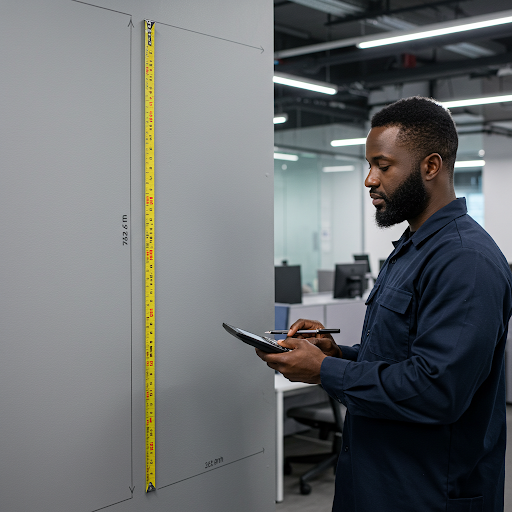
Before looking at patterns, you need the raw dimensions of every wall you plan to cover. Take the measurement from the base of the wall (where the baseboard is located) to the ceiling.
Take precise measurements at two or three points on the wall (left corner, center corner, right corner). This is because floors and ceilings can have uneven slopes, and you might only discover this after you’ve applied the wallpaper.
- Write down the highest height among the three measurements.
- Also, consider a little more for trimming later (more on this later)
This is a very common mistake in wallpaper measurements that people don’t take into account, and it’s only when they run out of wallpaper that they realize this error.
Step 2: Measure the width of each wall (separately)
Measure each wall from corner to corner.
Even if the room appears symmetrical, measure each wall anyway. Older houses, especially, can look quite similar, but not necessarily on paper.
- Wall 1: 12 feet
- Wall 2: 10 feet
- Wall 3: 12 feet
- Wall 4: 10 feet
The above measurements are the basis for taking accurate measurements of the walls for wallpapering.
Step 3: How to measure for wallpaper around windows and doors
This is where many people get confused. Here’s the truth:
Option A (suggested for DIY): Do not deduct doors/windows
Most DIY enthusiasts prefer to measure as if there are no doors and windows for the following reasons:
- Paper will still be wasted when cutting around the frames.
- You’ll need a little more for errors and matching patterns.
- It’s easier if you start with wallpapers.
This method generally corresponds quite well with how a wallpaper roll calculator works.
Option B (more accurate): Subtract large openings
Only if you are sure and want to reduce the excess:
- Each door/window should be measured width × height
- Then subtract that area (or adjust your strip count)
My recommendation: I only reduce the size of very large openings (for example, large sliding doors). For standard windows and doors, I don’t, mainly because the savings are rarely as great as people think.
This also applies to wallpaper coverage: the greater the number of cutouts, the less “usable” scraps will be left.
The method that really works: counting strips (drops), not just calculating square meters
Numerous guides suggest measuring the entire wall surface and then dividing it by the roll’s coverage. This allows for quick estimates; however, it’s not very effective when:
- Your walls are high
- The wallpaper has a repeating pattern.
- You need to match patterns
Instead, you should use the strip method, which is the most reliable, and this is basically what a good wallpaper measuring guide would tell you.
Step 4: Determine the length of your “drop” cut
The drop length is equal to the height of the wall plus the trimming margin.
Besides,
- You should add an extra 2 to 4 inches (5 to 10 cm) at the top and bottom.
Thus, if the wall height is 8 feet, the usual cut for each strip will be approximately 8.5 feet.
In the case of wallpapers with repeating patterns, the drop length may increase, as it may be necessary to offset the pattern to achieve a match. For this reason, a roll of wallpaper is often required for patterned wallpapers.
(If you’re wondering how to determine the amount of repeating pattern wallpaper, the easiest method is: always round the cut length up so the pattern can be aligned.)
2. Calculating for Preprinted Wallpaper
Standard wallpaper comes in rolls, and the trickiest part is the Pattern Repeat. If you have a large floral design, you’ll lose length lining up the flowers from strip to strip.
The Steps:
Find the Square Footage
Multiply $Total Width \times Total Height$.
Check the Roll Label
Standard US rolls are usually ~27 square feet, while European (metric) rolls are ~56 square feet.
Account for the Repeat
Random Match
No waste.
Straight/Drop Match
Add 15–20% to your total square footage to account for the “lost” paper used to align the pattern.
The Formula
Always round up to the nearest whole number.
3. How to measure for wallpaper customization
Custom orders are usually printed to your specific dimensions, so you aren’t dealing with “rolls” in the traditional sense. However, walls are rarely perfectly square.
The “Safety Margin” Rule:
When ordering custom, add 2–3 inches (5–8 cm) to both your total width and total height.
Why?
Houses settle, and walls tilt. If your wall is 1/2 inch taller on the right side than the left and you ordered the exact height, you’ll end up with a gap at the bottom. Adding a margin allows you to “bleed” the image over the edges and trim it perfectly for a flush look.
Reference Table on How to Measure for Wallpaper
| Feature | Preprinted Rolls | Custom Murals |
| Unit of Sale | Fixed-size rolls | Square footage/meters |
| Waste Prep | 15–20% extra for pattern matching | 2–3 inches extra on all sides |
| Trimming | Done at every seam and edge | Done at the outer perimeter |
| Best For | Repeating patterns, smaller budgets | Large-scale art, accent walls |
Choosing between preprinted and custom isn’t just about the design; it changes how you buy, cut, and survive the installation process.
1. Unit of Sale: Rolls vs. Exact Fit
Preprinted Rolls
These are mass-produced. You are buying a fixed “container” of paper. Because of this, you’ll almost always have leftover scraps (the “wastage”). You have to play a game of Tetris to fit those fixed widths onto your specific wall width.
Custom Murals
These are “Print on Demand.” The manufacturer takes your specific dimensions and scales the image to fit. You pay for the square footage of your wall, not a predetermined roll size.
2. Waste Prep: The “Buffer” Strategy
Preprinted (The Match Tax)
When you hang the first strip, the second strip must be shifted up or down to align the pattern. If the pattern repeat is 25 inches, you might have to cut off 20 inches of perfectly good paper just to get the flowers to line up. That is why you buy 15–20% extra.
Custom (The House Shift)
Custom murals don’t have a “repeat” because the whole wall is one big image. Your only enemy is a crooked wall. By adding 2–3 inches of “bleed” to your height and width, you ensure that if the ceiling dips slightly, you’re still covered.
3. How to measure for wallpaper trimming: Where the Blade Meets the Paper
Preprinted
Installation involves managing multiple narrow strips, requiring precision at every junction. Because these rolls come in standard widths, you will perform repetitive trimming at the ceiling and baseboard for every single panel. If you are aiming for a seamless “sophisticated” look, you might use double-cutting—overlapping two strips and slicing through both to create a perfect butt-joint. This process demands constant alignment checks to ensure the repeating pattern remains level across the entire expanse.
Custom
Custom murals arrive in wide, bespoke panels designed to form a singular, cohesive image. Unlike rolls, the priority is centering the artwork so the focal point sits perfectly on your wall. You apply the panels with the pre-calculated “bleed” overlapping your edges. The process concludes with a final, satisfying trim around the entire perimeter. By slicing away the excess safety margin along the ceiling, floor, and corners, you compensate for wonky, out-of-square walls effortlessly.
4. Best For: Budget vs. Impact
Preprinted
Ideal for covering an entire room or a hallway. Since it’s mass-produced, it is generally more cost-effective per square foot. It’s the “marathon” option.
Custom
Best for a “wow factor” accent wall—think a giant map, a forest scene, or a specific piece of art. It’s more expensive, but it’s the “sprint” option that creates a singular focal point.
How to measure for wallpaper types of walls (real-world situations)
Standard walls
There’s nothing special here:
- Height (use the tallest measurement)
- Broad
- Repeat for each wall.
How to Measure for Wallpaper Walls with niches or fireplace mantels
Treat them as separate walls:
- Width of the rear section
- Left return depth
- Right return depth
You’ll thank yourself later when you cut the strips and things actually fit together.
How to Measure for Wallpaper Sloping Roofs or Stairwell
Wear:
- The maximum height the wallpaper will reach
- Wall width
Plan ahead, as you’ll be cutting and discarding more with angled cuts. That’s why people look for ways to measure angled walls for wallpapering, since it’s very easy to underestimate the measurements.
How to Measure for Wallpaper without mistakes (that cause a shortage of rolls)
This is what confuses people the most:
- Measure the height once and assume it is consistent.
- Forgetting the trim margin
- Ignoring repeating patterns (a big problem!)
- Round down instead of up
- Extraneous areas (returns, niches, boxed sections) are not taken into account.
If you’re wondering how many rolls of wallpaper you’ll need, the honest answer is: enough so you can round it up and not be afraid of running out in the middle of a project.
Example calculation (with real numbers)
Let’s use a simple room.
Room:
- Two walls are 12 feet wide.
- Two walls are 10 feet wide.
- Total width = 12 + 10 + 12 + 10 = 44 feet
Wall height:
- tallest measured height = 8 feet
- Add a trimming allowance = approximately 0.5 feet
- Therefore, the drop length = 8.5 feet
Wallpaper roll:
- Width = 20.5 inches (approximately 1.71 feet)
- Length = 33 feet
- No pattern repetition (solid/random)
Step 1: How many strips do you need?
Total strips = total wall width ÷ roll width = 44 ÷ 1.71
25.73 → rounding → 26 strips
Step 2: How many strips come from one roll?
Strips per roll = roll length ÷ drop length = 33 ÷ 8.5
= 3.88 → round down → 3 strips per roll
Step 3: How many rolls?
Rolls = strips ÷ strips per roll
= 26 ÷ 3 = 8.67 → rounding → 9 throws
✅ Final answer: 9 throws
In the case of a noticeable repeat, you will probably need one more roll (and, in some cases, even more, depending on the size of the repeat and the height of your wall).
Conclusion: the simple practice that makes wallpapering easier
If you only remember this to do it: measure the height at different points, take the highest measurement, and calculate it by strips, not just by square meters. This is the most reliable method for measuring walls for wallpapering, so you won’t run out of paper, especially with patterns and irregular walls.
When you do it for the first time, you’ll know it’s not difficult; it just requires some concentration.