



Description
Professional wallpaper installation is a meticulous, multi-stage process that ensures the wallcovering’s longevity. Complexity escalates significantly from standard repeating patterns—which require basic pattern matching—to unique, custom-made murals, which demand expert panel alignment, precise image continuity, and specialized handling to achieve a seamless, high-impact result.

Whether you’re looking to wrap a room in a classic damask or turn a feature wall into a misty mountain range, the difference between a DIY headache and a flawless finish usually comes down to the installation.
Professional Associations of Wallpaper Installers

Industry excellence is upheld by key professional organizations that set global and local standards for craftsmanship. Globally, the Wallcovering Installers Association (WIA)—formerly the National Guild of Professional Paperhangers—is the premier body, offering specialized certification and continuous education to ensure installers master complex materials and techniques.

Locally, we are members of the Association of Designers of Kenya (ADKe) serves as a critical professional body. Registered under the Societies Act, ADKe advances standards across interior design and related finishing trades. By fostering a network of certified professionals and firm members, ADKe ensures that high-end installations meet both international quality benchmarks and local regulatory ethics, bridging the gap between design theory and technical execution.
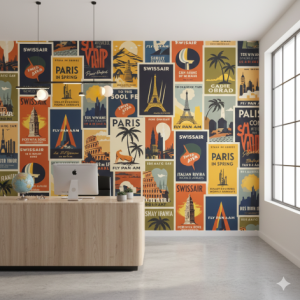
Professional wallpaper installation is as much about chemistry and geometry as it is about aesthetics. Here is an overview of how the pros handle standard rolls versus custom murals.
1. Professional Installation of Standard Wallpaper Rolls
Professional wallpapering is a blend of technical expertise and calculated rhythm. When dealing with standard rolls, the installer focuses on maintaining the integrity of the repeat across every corner and architectural obstacle.
1. Professional Installation of Standard Wallpaper Rolls
Standard rolls are the traditional choice, featuring repeating patterns like florals, textures, or geometric shapes. They come in set widths and require a rhythmic approach to ensure the repetitive design flows seamlessly and consistently across the entire room’s horizontal perimeter.
The Match Game
Professional wallpaper installation must meticulously account for the “pattern match” before the first cut. This calculation determines exactly how much paper will be wasted and how the individual strips must align to create a continuous visual experience without any jarring breaks.
Straight Match
In a straight match, the pattern elements line up horizontally across the wall. Every strip starts at exactly the same point in the design, making it a predictable alignment type for installers to manage during the hanging and trimming process.
Drop Match
A drop match is a complex alignment where patterns shift vertically between strips. This means every other panel is identical. It requires intricate cutting and results in higher waste, but creates a more dynamic, high-end look on the finished wall.
Random Match
Common in textured or grasscloth styles, a random match requires no specific horizontal or vertical alignment. Strips are hung side-by-side without needing to connect, though professionals often “reverse-hang” every other strip to ensure subtle color consistency across the wall.
The “Double Cut”
For a flawless finish, many installers use the “double cut” method. They overlap the edges of two panels and slice through both layers simultaneously with a surgical blade. This creates a perfect, invisible butt-joint that standard edge-to-edge hanging cannot match.
Material Variables
Professionals adapt their technique based on the backing. Non-woven papers allow for “paste-the-wall” convenience, while paper-backed varieties require “booking” time. This expansion period ensures the paper reaches its full size before installation, preventing post-hang bubbles, gaps, or shrinkage.
2. Installation of Custom-Made Wallpaper Murals
Murals are a different beast. Unlike rolls, these are often printed to the exact dimensions of your wall as one large-scale image.
Precision Mapping
Since there is no repeating pattern, there is zero room for error. Installers often “dry hang” or layout panels on the floor first to ensure the image continuity is perfect.
The Centering Factor
A professional will find the center point of the wall and work outward to ensure the most important part of the image isn’t chopped off by a corner or a door frame.
Material Strength
Murals are often printed on heavy-duty vinyl or high-end fabric. These require specialized, heavy-duty adhesives to prevent the weight of the panels from sliding.
Comparison: Standard vs. Custom Murals
The differences between standard rolls and custom murals is essentially the difference between background texture and architectural storytelling. While they both go on the wall with paste, their “DNA” is completely different.
1. Design Logic: The “Repeat” vs. The “Scene.”
The most fundamental difference is how the eye processes the image.
Standard Rolls
These rely on a Pattern Repeat. Whether it’s a 53cm or 64cm repeat, the design is engineered to be modular. This makes standard rolls “forgiving” in large spaces because the rhythm of the pattern creates a cohesive, albeit repetitive, backdrop.
Custom Murals
These are Non-Repetitive. The image is one singular composition (a forest, a map, a marble vein). There is no “pattern match” in the traditional sense. Instead, there is Image Continuity. If you misalign a mural by even 2mm, a tree branch or a mountain peak will look “broken,” which is much more jarring than a slightly shifted floral pattern.
2. The Math: Calculating Wallpaper Waste
Professional wallpaper installers approach the ordering process for these two very differently.
Standard Rolls
Standard rolls require accounting for the “Waste Factor.” Because patterns must align precisely from one strip to the next, you often lose several inches at the top of every drop. This vertical shift ensures the design remains continuous, but it necessitates ordering extra material to cover the resulting loss.
Calculation
To calculate, divide wall height by the pattern repeat, rounding up to find the “usable” repeats per strip. Multiply the total strips needed by this adjusted height. Professionals typically add a 10–20% buffer for “drop matches” to ensure continuity when the design shifts vertically between panels.
Custom Murals
These are printed To-Fit. You provide the printer with your wall’s exact width and height. The manufacturer then prints the image across a specific number of panels.
The “Bleed”
Pros always order murals with a 2-3 inch “bleed” (extra margin) on all four sides. Since no wall is perfectly square, this extra material allows the installer to trim the mural to the actual (often crooked) perimeter of the wall.
3. Professional Wallpaper Installation Complexity
The “mental load” of a wallpaper installer isn’t just about physical labor; it’s about the cognitive tax of spatial reasoning and risk management.
While standard rolls require a marathon-like consistency, custom murals demand surgical, high-stakes precision. Here is the breakdown of the mental shifts required for each.
1. Standard Rolls: The Burden of Consistency
When installing standard rolls, the mental load is focused on rhythm and pattern geometry. The installer is playing a long game of “spot the difference” across an entire room.
The “Dye Lot” Anxiety
Even if the rolls look identical, a pro is constantly scanning for “shading”—subtle color shifts between rolls. The mental load involves tracking which roll came from which batch to ensure a dark edge doesn’t hit a light edge.
The “Creeping” Pattern
On a long wall, a pattern can “creep” (shift up or down by a fraction of a millimeter per strip). The installer must mentally project the pattern 20 feet ahead to ensure they don’t end up with a slanted room.
The “Booking” Timer
Many standard papers require “booking” (letting the paste soak). An installer often has 3–4 strips at different stages of “expansion.” Keeping a mental clock for each strip to prevent over-stretching is a significant cognitive juggle.
2. Custom Murals: The Burden of Irreplaceability
With a mural, the installer is essentially handling a one-of-a-kind piece of art. There is no “extra roll” in the van.
The “Hero” Factor
Every mural has a “hero” element—a mountain peak, a face, or a specific architectural line. The mental load starts with mapping. If the installer centers the mural on the wall but forgets there is a massive thermostat or light fixture in the middle, they might “lobotomize” the main subject of the image.
The Sequencing Trap
Standard wallpaper is modular; you can usually cut strip #4 from any roll. A mural is a sequence (Panel 1, 2, 3…). If you accidentally cut Panel 3 upside down or trim the bottom too short, the entire project is dead. You cannot simply “grab another piece.” This creates a high-pressure “measure five times, cut once” headspace.
The Double-Cut Stress
Most high-end murals require an “overlap and double-cut.” This involves overlapping two thick panels and slicing through both with a razor. If the hand wobbles or the blade is slightly dull, the seam is ruined. The mental focus required for a 10-foot vertical cut with zero errors is exhausting.
Mental Load Comparison Table
| Cognitive Stressor | Standard Rolls (The Marathon) | Custom Murals (The Surgery) |
| Primary Focus | Maintaining a repetitive rhythm. | Protecting image integrity. |
| Error Tolerance | Moderate (you usually have a spare roll). | Zero (re-ordering takes weeks). |
| Spatial Planning | Managing corners and obstacles. | Centering the “Hero” and managing “Bleed.” |
| Math Intensity | Calculating repeats and waste. | Exact wall-mapping and panel sequencing. |
| Physical Tension | Low but constant (long hours). | Extreme during the “Double-Cut.” |
4. Professional Wallpaper Material and Texture
Standard Rolls offer a wider variety of specialized finishes like flock (velvet), metallic foils, and grasscloth. Because they are mass-produced, manufacturers can use complex machinery to create these tactile effects.
Custom Murals are typically printed on High-Grade Non-Woven Paper or Commercial Vinyl. While they can be textured (e.g., a “canvas” or “sand” finish), they generally lack the 3D elements like raised velvet or real woven grass found in high-end rolls.
3. The Professional Wallpaper Installation Process
To achieve that seamless, high-end look, professional installers follow a rigorous technical protocol. While the process looks like art, it is driven by a series of precise, non-negotiable steps designed to prevent common failures like peeling, bubbling, or crooked patterns.
1. Professional Wall Prep
Professional preparation is the invisible foundation of a perfect hang. Installers begin by stripping old remnants and sanding surfaces to a smooth finish. They meticulously patch every divot and crack with high-grade spackle. The critical final step is applying a premium wallpaper primer, or “size.” This chemical barrier prevents the adhesive from soaking too deeply into the drywall, ensuring a strong bond now and effortless, damage-free removal whenever you finally choose to redecorate.
2. The Plumb Line
In the world of construction, “square” is often a polite fiction. Walls lean and corners drift, meaning you can never trust a door frame for alignment. A pro uses a laser level or plumb bob to establish a perfectly vertical “true north” on the wall. This initial guide prevents a subtle tilt that would otherwise compound across the room, ensuring patterns remain upright and murals don’t look like they’re sliding slowly into the floor.
3. Adhesive Management
Applying paste is a delicate balancing act of chemistry. Too much adhesive leads to “ooze,” where excess glue ruins the paper’s face or weakens the seams. Too little results in “dry spots,” causing the paper to bubble or peel as it cures. Professionals use specialized rollers to achieve a precise, consistent “mil” thickness. They also select the specific adhesive—clear, clay-based, or heavy-duty—perfectly matched to the wallpaper’s weight and backing for maximum, long-term durability.
4. Professional Wallpaper Installation Specialty Tools: The “Final 10%”
Beyond the three pillars of prep, plumbing, and paste, the “Mental Load” is lightened by using high-precision tools. These items allow a professional to execute the finishing touches that separate a luxury installation from a DIY attempt.
Surgical-Grade Snap-Off Blades
Precision is paramount, so pros rely on surgical-grade snap-off blades. A single room might require fifty fresh edges. The moment a blade loses its microscopic “bite,” it is discarded. This prevents the nightmare of snagging or tearing expensive, damp wallpaper.
Seam Rollers
These specialized tools are essential for professional wallpaper installation. By applying targeted, light pressure, the installer locks the edges firmly against the wall. This ensures a flat, invisible seam without accidentally forcing adhesive to ooze out and ruin the face.
Smoothing Brushes/Spatulas
Installers match their smoothing tool to the material’s delicacy. A stiff plastic spatula works for durable vinyl, while a soft-bristle brush is required for hand-painted silks. This careful selection prevents surface scuffing while effectively removing every trapped air bubble.
A-Z of Professional Wallpaper Installation Terms
To master the world of professional wallcoverings, one must speak the language of the trade. This glossary covers the essential technical terms used by installers to describe the behavior of paper, paste, and patterns.
Booking:
The process of folding a pasted strip of wallpaper onto itself (paste-to-paste) to allow the adhesive to soak in and the paper to expand. This prevents the paper from expanding on the wall, which causes bubbles.
Butt-Joint:
The most common seam type where the edges of two strips meet exactly without overlapping, creating a smooth, flat surface.
Double-Cut:
A technique where two panels are overlapped and cut through simultaneously with a sharp blade. The waste is removed, leaving a perfectly matched seam.
Dye Lot (or Run Number):
A number printed on the wallpaper label indicating it was produced in the same ink batch. Using different dye lots in one room can result in visible color variations.
Non-Woven:
A modern “breathable” wallpaper backing made of synthetic and natural fibers. It is typically “paste-the-wall,” meaning it does not expand or require booking.
Pattern Repeat:
The vertical distance between one point in the design and the next time that exact point appears. This measurement is crucial for calculating waste.
Plumb:
A perfectly vertical line. Installers use a “plumb line” (laser or weighted string) as their starting guide to ensure the wallpaper isn’t crooked.
Sizing (Primer):
A specialized coating applied to the wall before hanging. It seals the surface, provides “slip” for positioning the paper, and ensures the paper can be removed later without damaging the drywall.
Smoothing:
The act of using a brush or plastic tool to move air bubbles and excess paste from the center of a strip toward the edges.
Venting:
A technique used by pros to release trapped air by gently lifting a corner or using a fine needle to deflate a stubborn bubble.
Pro Tip: Never assume your “Standard” rolls are from the same batch. Professionals always check the Dye Lot/Run Numbers before a single drop of paste touches the wall to ensure color consistency.